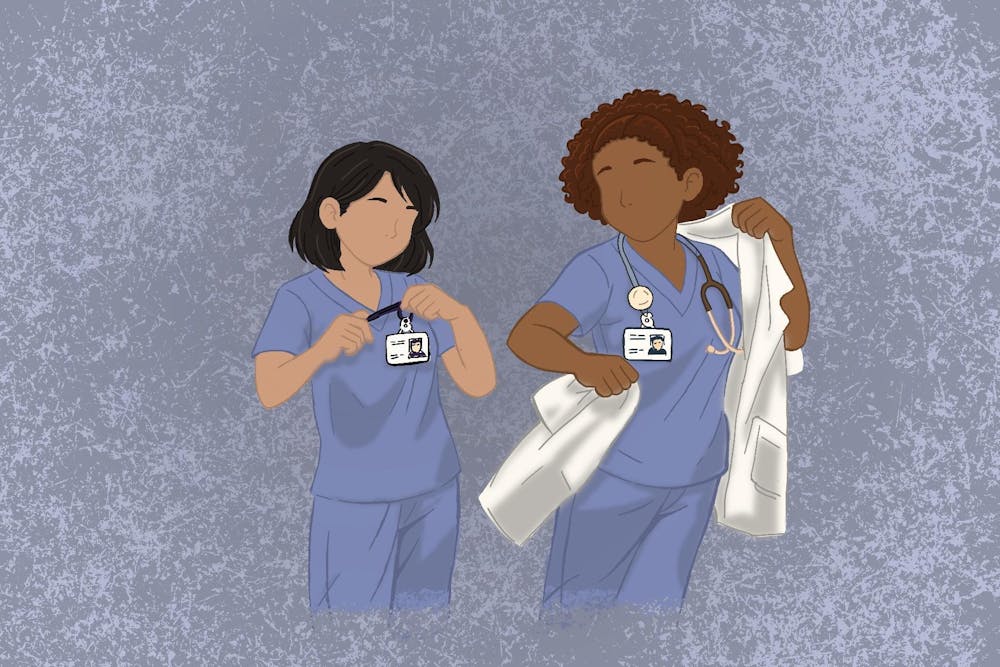
President Donald Trump’s Department of Education has proposed to redefine what is considered a “professional degree” for the purposes of maximum student loan amounts. In their proposal, eight degrees are no longer classed as professional, meaning they now qualify for a maximum of $20,500 per year in federal loans as opposed to $50,000 a year for degrees that remain classified as professional, such as law, medicine and theology. The most striking of the reclassified degrees is the graduate nursing degree. By moving to seriously limit the amount of financial aid that students in these programs can receive, the federal government will exacerbate an already troublesome situation in the healthcare labor market. Such a prospect is unacceptable, and the University must do its part in alleviating the burden.
The University dedicates itself to providing financial aid to those who need it, with its program offering loans, grants, scholarships and work study opportunities. With its financial aid program and huge fundraising successes in recent years, as well as their claim to meet 100 percent of demonstrated financial need, the University needs to follow through on their financing opportunities and assertions and make it a priority to provide support for nursing and medical students through targeted fundraising efforts — or risk falling behind on its programs and mission. With the University consistently being in the top 15 percent of graduate programs for nursing, a reduction in federal financial support for students’ loans may greatly decrease the number of students who attend the University. Consequently, with fewer students attending, the University will not be able to dedicate the resources needed to maintain the program’s prestige. In order to mitigate losing merit in their highly esteemed programs and continue with their commitment to care, the University must provide the necessary support to students working to get their degrees.
Beyond the confines of the University, eliminating nursing as a professional degree jeopardizes structural impacts on the education and employment of a crucial workforce. There is already a national shortage of nurses in an increasingly struggling field, with the demand for nurse practitioners expected to rise the highest of any occupation. Though the Department of Education claims to possess internal data that its reforms will not exacerbate the current nursing shortage, they pointedly decline to provide it to those concerned. The implications of this shortage are plentiful, ranging from longer hospital waiting times to increases in patient mortality. There is a long-established correlation between nursing shortages and patient deaths, with preventable deaths increasing substantially in understaffed hospitals. Without a doubt, the best solution to strengthen patient safety is an increased nurse-to-patient ratio, which is currently being overlooked as the nursing crisis continues to be neglected.
As the individual workload for nurses grows higher with the increasing lack of nurses, and as the financial costs of the degree continue to rise, the motivation for pursuing this career is diminishing. Because taking the professional status away from these degrees decreases potential financial assistance, underprivileged students and those in rural areas are much less likely to pursue these options, with others being persuaded to find alternative paths as well. Cutting the opportunities for students to work towards a graduate nursing degree further complicates all areas of the healthcare system, reducing the quantity of nurses and the quality of patient care, and our higher education systems need to address it.
A large part of the University’s mission is to honor and serve the surrounding community and the world at large. The recent and upcoming actions of the federal government will lead to catastrophic results for educational programs and hospitals alike. Although it should not have to fall on the University, it would serve the community well to make sure the vital fields we value so much do not dwindle in our future.
Adeline Garvie is a senior opinion columnist for The Cavalier Daily. She can be reached at opinion@cavalierdaily.com.
The opinions expressed in this column are not necessarily those of The Cavalier Daily. Columns represent the views of the authors alone.
Read More

EDITORIAL: College sports need fixing
By Editorial Board | YesterdayCollege sports, in their current state, are fundamentally broken, and they desperately need legislative stabilization and reform.

University Medical Center nears top safety grade, looks to improve in November
By Michael Racz | 3 days agoIn the spring 2026 Leapfrog Hospital Safety Grades, the University Medical Center received a “B” grade — the second-highest grade awarded by The Leapfrog Group — with a numerical score of 3.18, just 0.02 points below the threshold for an “A.”

U.Va. Health System Board discusses leadership turnover, telehealth initiatives across the system
By Michael Racz | 5 days agoThe Board of Visitors’ Health System Board met Thursday and discussed recent leadership changes across the Health System, presented a new set of strategic pillars and priorities and distributed information on the history and current status of U.Va. Health’s telemedicine offerings.