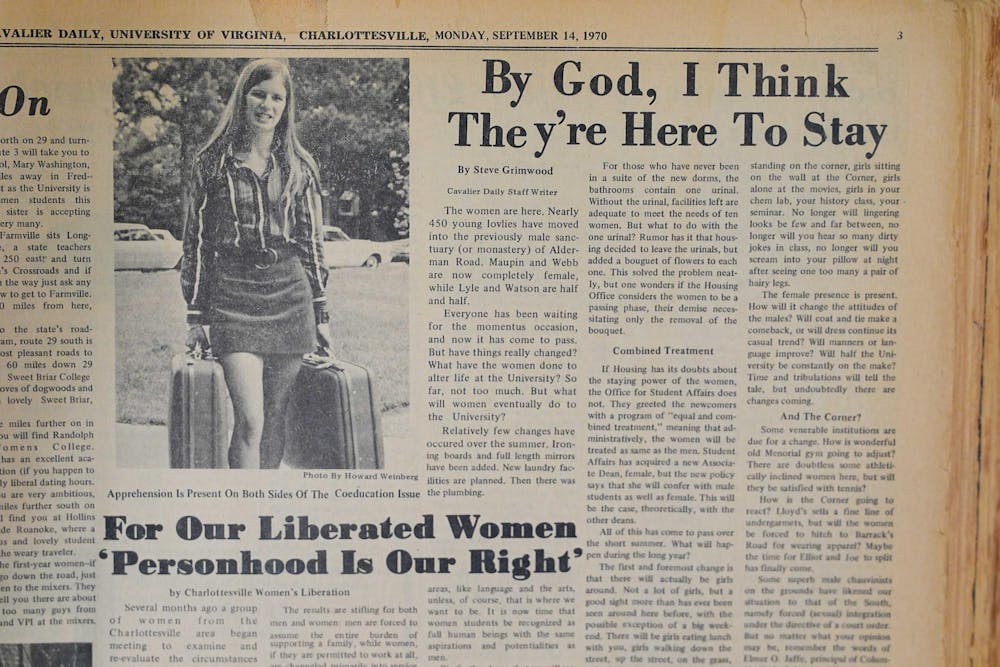
Gail Gerry arrived at the University in 1970 as part of the first undergraduate coeducational class. Entering as the result of a divisive decision, the presence of women was not universally celebrated. Some male students refused to sit beside them in class, and many believed the University had made a huge mistake by letting a coeducational class of women in at all. This reaction and treatment sparked a fire in many of the women, and left several feeling as if they had something to prove.
More than 50 years later, Gerry is revisiting and unpacking those early years in her book “Here to Stay: The Story of the Class of Women Who Coeducated the University of Virginia,” which documents the experiences of her and the hundreds of other women who entered the University as part of the first coeducational class.
According to Gerry, a defining part of these women's experiences was their grit and determination to succeed despite the challenges they faced, a theme that is highlighted throughout “Here to Stay.” Amid today’s changes to diversity, equity and inclusion efforts at the University, Gerry emphasized that her book serves as a reminder that the University's progress has been undeniably driven by students who were once told they did not belong.
The idea for the book emerged when Gerry began searching for a narrative of the women in the University’s first coeducational class, and realized that none existed. Curious about how such a significant moment in the University's history had gone largely untold, she began sifting through archives and speaking with former classmates to piece together the story herself.
“I know my story, but what is the story of the 367 women that entered in September 1970,” Gerry said. “I started searching and looking for a book, and nothing had been written. There have been a couple of dissertations. There have been some chapters and books on coeducation, but no book that charted the journey of the females here at U.Va.”
While much of the existing work on coeducation centers on the institutional side, Gerry set out to focus on the stories of these women — from navigating exclusion and belittling to the incredible friendships and sense of community that carried them through.
“Really what I focused on, what I wanted the book to be, was the human side of institutional transformation,” Gerry said.
According to Gerry, when that class of women made their way onto Grounds in 1970, they arrived knowing they would face hostility. As she discovered while doing research for her book, resistance to admitting women had been very openly expressed by some alumni.
“When I was in the archives reading particularly alumni letters about why they didn't think U.Va. should go co-ed, they talked a lot about [how] women would only want to come to find a husband,” Gerry said. “There were lots of other things that were even more derogatory.”
Inside classrooms, women found themselves forging their way through spaces that had been built with male students in mind. In every room, the language around them reinforced the idea that women did not belong, with classroom honor code plaques referring to “a Virginia gentlemen.” Gerry even recalled being told by older faculty members to just keep a low profile.
“We were told, just sit in the back. Keep your head down,” Gerry said.
Beyond academic culture, the infrastructure of Grounds further perpetuated day-to-day challenges for female students. Gerry’s dorm was located far from Central Grounds. With a lack of public transportation and proper lighting in the streets, trips to the library at night often felt unsafe.
Gerry recalled that some male peers openly belittled the women, describing their presence at the University as an “experiment” and suggesting that if coeducation failed, the University could simply go back to the way it was before.
Others tried to place guilt on the women for choosing to attend at all, suggesting that they were taking the place of a male soldier who was actively serving in Vietnam — a claim Gerry said was far from true. Comments like these created a high-stakes environment where many of the women felt they had to work even harder to be taken seriously.
Rather than fostering a sense of competition among the women, this pressure to achieve instead strengthened their sense of solidarity and determination to succeed.
“I felt a whole lot more collaboration and cooperation and support from my fellow female students,” Gerry said. “ We all wanted to do well. We wanted to prove that we belonged.”
Despite feeling outnumbered by the thousands of men on Grounds, Gerry reflected fondly on the sense of camaraderie she found within her fellow women and how they leaned on each other for support and sisterhood during those times.
“The friendships [I made] are very long-lasting and very, very deep,” Gerry said. “Another female friend helped me with this book.”
While sisterhood was strong, female mentorship was often harder to come by, as few departments had female faculty members. Luckily, the same year Gerry began, so did Mavis Hetherington, Professor Emeritus of psychology, who would become an influential mentor for many of the women at the time. Still, role models like Hetherington were scarce.
“The only female professors I had were language teachers … Mavis Hetherington came in with us in psychology, and she took a lot of us under her wing,” Gerry said. “She just died at 96. I had had the privilege of talking to her a couple years ago, and she was a really strong woman and really a role model, but there weren't enough of them for us to really find someone that would take us under the wing and help us ensure our path.”
While Gerry said that many of the conversations she had with former classmates while writing “Here to Stay” brought back joyful memories of friendship and community, she also said that revisiting the past meant confronting more difficult and painful memories.
As Gerry spoke with friends and classmates, some women shared experiences of harassment and sexual assault.
“I was familiar with some of [accounts of sexual assault] from experiences of my friends and others that talk to me, but it disturbed me,” Gerry said. “And it continues to disturb me, that women in particular have to navigate that as well as everything else they're working through.”
The accounts were difficult to revisit, but Gerry said that including those stories was necessary to fully and honestly represent what these pioneering women at the University experienced.
Broadly, Gerry also said that she was struck by how much appreciation many former classmates still hold for the University and the experiences they had.
“Many of us felt that our journey pretty much prepared us for whatever we were going to encounter in our lives beyond [Grounds,]” Gerry said. “We were all going to be in situations where we're uncomfortable, or we may not feel we belong."
She noted that many of the women from that first class later went on to law school, medical school and other graduate programs. Their achievements truly exemplify the resilience of a group determined to prove they belonged. Seeing what her classmates went on to accomplish, Gerry said, gives her a deep sense of pride.
Gerry also offered advice for women entering fields or spaces that can still feel male dominated. Drawing on anecdotes from women she interviewed for “Here to Stay,” she emphasized the importance of confidence and constantly persisting.
She recalled one woman profiled in the book, Barbara Savage, who later became Professor Emerita of American Social Thought and Africana Studies. Gerry said that early in Savage’s career, she often found herself walking into rooms where she was the only woman and person of color.
“She said, ‘I'd walk into a room that was all white men,’” Gerry said. “‘And I think to myself, I've been here before, I've done this, and I can do this.’”
For Gerry, the determination shown by those women at the University serves as an important lesson for students today. While environments may still feel intimidating, she said recognizing one’s own place in those spaces is essential. She also stressed the importance of embracing diversity and learning from people with different backgrounds.
“I really think the themes in [the book] are as pertinent today,” Gerry said. “Resilience and persistence and grit and you know, just really sort of staying the course even when times make you think ‘this isn't the path for me.’”
Through “Here to Stay,” Gerry hopes the stories of the women of the University’s first coeducational class — their trials and tribulations, their friendships and, most importantly, their grit and determination — remain an integral part of the University’s history and serve as an inspiration to students today who may feel they do not belong.
“Everybody belongs,” she said. “That diversity is the key to a healthy ecosystem.”
Read More

Sarah Deloney’s path to — and from — her diagnosis
By Astrid Cheng | 2 days agoAfter three years of persistent pain, Deloney was finally able to find an answer — Nutcracker Syndrome.

Animal lovers come together at Charlottesville-Albemarle SPCA’s third annual Fall Fest
By Lily Notter | 2 days agoFall Fest is the CASPCA’s largest adoption event of the year.

No diet, no glory: My complicated relationship with dieting and eating
By Phoenix Banks | 3 days agoMy weight and what I was going to do about it have been a topic of conversation my entire life.