Across many professional fields — finance, technology and manufacturing, to name a few — leadership roles have historically been male-dominated. Today, this discrepancy continues to be reflected through many conventions and practices in the professional world. In 2024, women held only 9 percent of CEO positions in Fortune 500 companies — with women of color accounting for less than 8 percent of CEO positions and board seats in these organizations.
While many women in the corporate world have grown to expect this narrative, a group of students on Grounds are actively working to redefine it through the U.Va. chapter of Women Entrepreneurship.
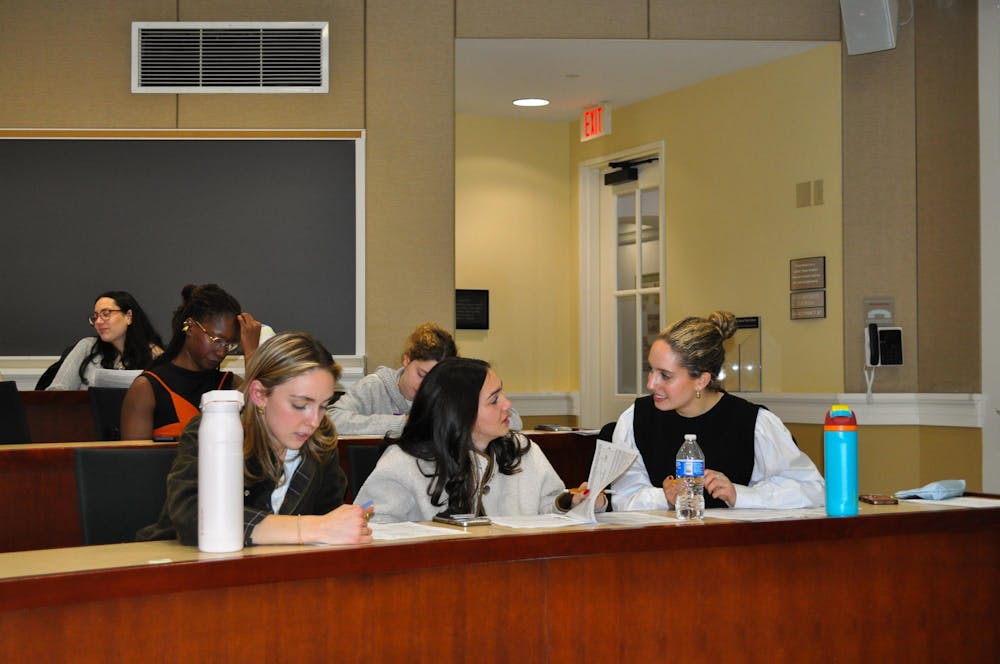
WE at U.Va. is part of the global organization Women Entrepreneurship, which empowers women to develop entrepreneurial and leadership skills through mentorship and community. On Grounds, the organization creates spaces where women can connect with other members, accomplished role models and begin to envision themselves in positions of leadership.
Established in 2024, the University's chapter of WE brings its mission to life by hosting keynote speaker events, professor-led seminars and networking panels. Recent on-Grounds programming has included a talk by Virginia Covo, 2016 Darden graduate, former Director of Sustainability at Anheuser-Bush InBev and Founder of Greentor, a climate-tech startup, who spoke about her career journey. Although a brief Google form is required to become a member of WE, all students are welcome and encouraged to attend its events.
Drawing on her early experiences navigating male-dominated professional spaces on Grounds, Sofia Lombard, president and founder of WE at U.Va. and third-year College student, established the chapter to foster a more inclusive and supportive environment for women. It was only after organizing a successful speaker-event through a first-year consulting club that she began to recognize both the demand for and absence of a community for women in entrepreneurship and leadership at the University.
“[In my] first and second year, I was at the [McIntire School of Commerce] all the time for these networking events … And I couldn't help but notice the masculine energy of the room every time,” Lombard said. “That fueled the fire for me to continue with entrepreneurship and say, ‘Hey, this is for myself and for everyone else in the room here who wants mentorship [and] … visibility, and we just don't have it.’”
Although still new to Grounds, WE was granted official CIO status as of December, marking a significant milestone in the organization’s growth and institutional recognition. Still, the organization’s trajectory has not been without its challenges. Lombard recalled a pivotal moment during the Spring semester of her second year, when rapid growth without sufficient internal structure forced her to pause and reassess the organization's foundation.
In turn, Lombard established a full corporate exec board, the structure of which has proven instrumental in sustaining WE’s rapid growth. Lombard reported that membership expanded from a handful of students to more than 100 members, with the majority of that increase taking place in the fall of 2024. Second-year College student Shannon O’Connor, who joined WE in her first year, attributed her interest in the organization to its flexible nature and social element.
“It's just a good group of girls,” O'Connor said. “It's definitely kind of social, friends invite friends who invite friends. … I also think you can get out of it what you want — you can go to all the speaker events [and] talk to all the speakers and get to know them … Or you can just get to know the girls in the organization and try and reach out.”
Echoing this sentiment, Lauren Lin, WE member and third-year Commerce student, decided to join the organization after transferring to the University at the beginning of the Fall semester. Lin explained how she was drawn to the organization by the promise of a supportive, like-minded community, and noted that WE felt different from the more competitive environment she had experienced elsewhere in McIntire.
“These [Commerce students] are so incredible. I feel like I'm not on their level, but [WE] was different. [In] the first couple of sessions I went to, I didn't feel [inferior],” Lin said. “I was really inspired to dream big sitting in that room, whereas when I'm sitting in my [Commerce] classroom, I feel very little.”
WE’s supportive community is perhaps what initially draws members in, yet its impact seems to extend into shaping how members and those in leadership come to understand entrepreneurship. Kelly Neuner, chief operating officer of WE and second-year Commerce student, says her experience as both a general and executive member of WE has deepened and reaffirmed what “entrepreneurship” means to her.
She explained that while she was raised to feel confident in her abilities to succeed in entrepreneurship, after arriving at the University, she became aware of the broader gender-based stigma surrounding entrepreneurship.
“Whether it be entrepreneurship or investment banking, I even noticed how the ratio of men in the room to women at these information sessions was drastically off,” Neuner said. “But I think as a whole, it's just women in business. That is what entrepreneurship is starting to mean to me.”
The organization’s speaker events hone this emphasis on connection, where conversations often extend beyond career advice to challenge how members think about their own ambitions. For Neuner, one such event that took place during her first year — featuring guest speaker Lily West, 2012 Darden graduate and President and CEO of the U.Va. Alumni Association — left a particularly lasting impression.
“[Lily West] was so wise and just made so many points that I still remember today,” Neuner said. “She made this point about, ‘Do you feel like you want to do this or do you feel like you should do this?’ It transformed my perspective on things and had such a big impact … that I was like, [WE] is something that I could really see myself being involved in.”
While WE has successfully fostered connections between speakers and event attendees, Lombard noted that building a strong internal community among members remains an ongoing priority — particularly as the organization continues to develop more defined benefits for its members.
“The on-Grounds community is something we're working on, because … we don't have [many] internal benefits for members yet,” Lombard said. “That's something we want to fix by having more social events and more exclusive events for members.”
As WE at U.Va. continues to flourish, its impact extends beyond professional development by shaping how members understand entrepreneurship and their place within it. For many, the organization has reframed entrepreneurship into something more expansive, rooted not only in innovation, but in empowerment and representation.
“Because of this club, I've realized how important it is … to empower women, and how entrepreneurship means something bigger than just creating a product,” Neuner said.
Read More

No-bake date bark brings a taste of joy to all sweet treat lovers
By Lily Notter | 13 hours agoWhether you eat these bars with friends, as a solo study snack or after family dinner, they are a delicious and nutritious addition to any day.

Delicious on a dime: Charlottesville’s best restaurant deals
By Lucy Larsen | 6 days agoFrom wraps and wings on the Corner to imported wine and tapas on the Downtown Mall, these are the perfect spots to treat both your taste buds and your wallet for under $25.

Play the organ
By Elizabeth Adams | September 25, 2026The college side quest does not need to be the multi-semester jaunt that my organ adventure has become, and it certainly doesn’t have to make sense.