“What are the guiding principles for the future of college athletics?”
That was the question former Alabama Football Coach Nick Saban posed at the White House March 6. In 2026, it is a question that both experts and the public alike seem unable to answer.
For decades, collegiate athletes generated billions of dollars without earning a cent in return. Since the introduction of Name, Image and Likeness in 2021 — after NCAA v. Alston ruled that restrictions on education-related payments violated antitrust law — the so-called NIL era has promised a new kind of opportunity for student-athletes.
Now, these athletes have the chance to build their careers, finances and lives within and beyond their sport, including through brand endorsements, NIL collectives or social media monetization.
Sounds straightforward, right?
Not quite.
As NIL has gained a foothold in collegiate athletics, it has also opened Pandora’s box — a system defined by secrecy, inequities and glaring imbalances. While some programs have transformed NIL into a pipeline of millions of dollars, others are left navigating a system with few rules and even fewer solutions.
At its core, the NIL marketplace is wild. Some universities, such as the University of Colorado, disclose how they share revenue, while others release little to no information — citing privacy laws or competitive disadvantages that would ensue if data were released. Even beyond the lack of transparency, the system itself is a vacuum built to reward visibility, funneling money toward star athletes and powerhouse programs that already command national attention and resources.
Additionally, Title IX — a federal law mandating schools to serve men’s and women’s sports equitably — does not even apply to the NIL marketplace because universities are not paying athletes directly.
When the data is available, the disparities are impossible to ignore. From July 1, 2021, to Feb. 28, 2022, 71.7 percent of NIL compensation and brand deals were distributed to male athletes. Across collegiate athletics, the overwhelming majority of NIL flows toward men’s basketball and football. On the other hand, women’s programs receive a mere fraction of that share — even when their success matches or exceeds that of their male counterparts.
Gender inequity is not just an isolated issue within NIL — it is a result of how the entire system was constructed.
At the University, NIL distributions reveal both the promise and contradiction of the revenue-sharing system, at least according to aggregated data. Football and men’s basketball account for over half of the total NIL earnings, reinforcing the sport hierarchy visible nationwide. The men’s basketball team had earned at least eight times as much revenue from NIL as the women’s team as of October 2024.
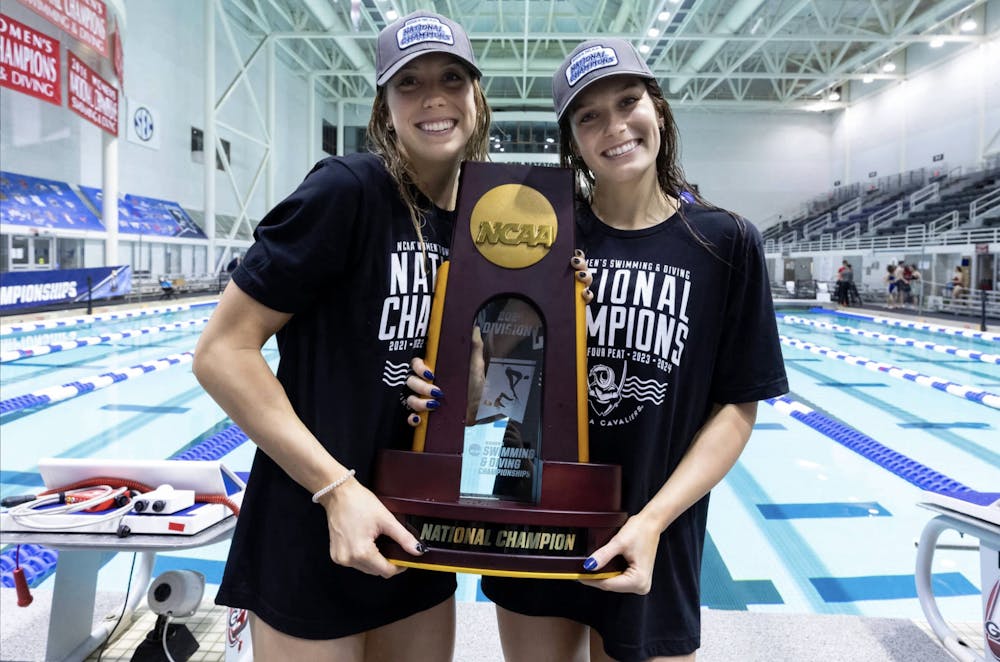
Yet NIL earnings also relate to team performance, complicating that hierarchy. As of late 2024, the Virginia women’s swimming and diving team has generated $1.1 million — more than the football team — comprising 31 percent of the University’s total NIL revenue since July 2021.
While the women’s swim and dive program outperformed football in total revenue, they did so with a sweep of national championships, powered by megastars including Alex and Gretchen Walsh and Kate Douglass, who have combined for four Olympic gold medals among other endless accolades. Success and star power become strong leverage for NIL.
Football revenue, by contrast, is spread across a much larger roster. Still, the fact that it accounts for nearly 25 percent of NIL records is striking given the team’s two three-win seasons in 2022 and 2023. Even when women’s programs are more successful, the systemic flow of money still defaults to the “big two” of men’s football and basketball teams.
In some ways, the University is adapting its front office to deal with these changes. Virginia Athletics announced the hiring of Clay Walker to serve as the University's first NIL Division General Manager.
“Since the House settlement last summer, we’ve been hard at work developing a strategic plan to create a true competitive advantage for Virginia Athletics,” Deputy Athletics Director, Chief Strategy Officer and General Manager Tyler Jones said. “The addition of Clay and U.Va. NIL is a huge piece of ensuring that U.Va. can compete for top-tier talent across all of our rosters.”
We are witnessing a system that requires women’s collegiate athletes to be legendary just to profit the same amount as their male counterparts.
And yet, the gap is not simply a matter of marketability. Despite the discrepancy in NIL distribution, many women athletes are strategically positioned to succeed in the NIL era because they generate broader market appeal through more authentic social media presences. Their proactive, authentic branding can build uniquely strong NIL engagement. A handful of stars have capitalized on that position, becoming some of the most recognizable faces in collegiate sports.
Take UCLA gymnast Jordan Chiles, for example, an Olympic gold medalist with nearly two million social media followers. As of late 2024, the seven largest NIL deals associated with UCLA gymnastics totaled $1.3 million — all involving companies Chiles has advertised. Her endorsements boosted UCLA’s total disclosed NIL sponsorships of $3.2 million among female athletes.
But the success of stars such as Chiles is the exception, not the rule — which reveals a paradox at NIL’s epicenter. Although women may be very well-suited for the marketplace, the marketplace is not structured to support them broadly.
For most women athletes, that paradox translates into a far narrower reality. Though most NIL deals account for less than $1,000 more for men and women alike, women’s athletes are 15.3 percent more likely than men to hold small deals for less than $100 and 21.8 percent less likely to make middle-of-the-road deals between $1,000 and $19,999.
For athletes outside of high-profile, nationally competitive programs, the divide only intensifies — as narrow visibility and fewer institutional resources further restrict access to NIL opportunities.
Without the same institutional backing, media exposure and built-in audiences as men’s collegiate sports, women athletes often face smaller and less accessible NIL opportunities — and the fact that the vast majority of universities do not disclose this data only further obscures the full extent of these disparities. Outside of a small handful of nationally recognized programs, visibility is limited — and in a system that rewards attention above all else, that limitation becomes decisive.
So, as Saban asked at the beginning of this month, what are the guiding principles for the future of college athletics? If NIL has shown the country anything, it is that the system is being written out extemporaneously — one in which visibility, institutional power and marketability ultimately outweigh fairness, leaving women’s programs and less-prominent programs to navigate an uneven playing field.
NIL has created opportunity — but not equally. Instead, it has concentrated benefits among the athletes and programs already positioned to succeed.
Until institutions, including the University, enforce transparency and confront these disparities directly, NIL will not only lack a consistent framework — it will simply repackage its inequities under a different name.

Sofie Keppler is a senior writer on the sports desk. She is a second-year Commerce student. Originally from Evansville, Ind., Sofie enjoys covering women’s basketball, soccer and golf.
Read More
Five takeaways from the first two Virginia men’s basketball exhibition showcases
By Jordan Zimm | 14 hours agoWith one more exhibition remaining at Villanova Thursday, here are five takeaways from Virginia’s first two preseason tests.

Virginia volleyball looks to extend historic winning streak to 10 against Virginia Tech
By Jonathan Altshuler | 14 hours agoWhile both teams have struggled recently, Wednesday’s result further strengthened the Cavaliers' advantage in the rivalry — which remains one-sided.

Virginia volleyball extends winning streak against Virginia Tech with four-set victory
By Jonathan Altshuler | YesterdayThe Cavaliers defeated the Hokies in four sets Wednesday night at Memorial Gymnasium with scores of 25-19, 25-19, 22-25 and 25-23. This was the Cavaliers’ first win since Sept. 25, extending a five-year winning streak against the Hokies since 2022.