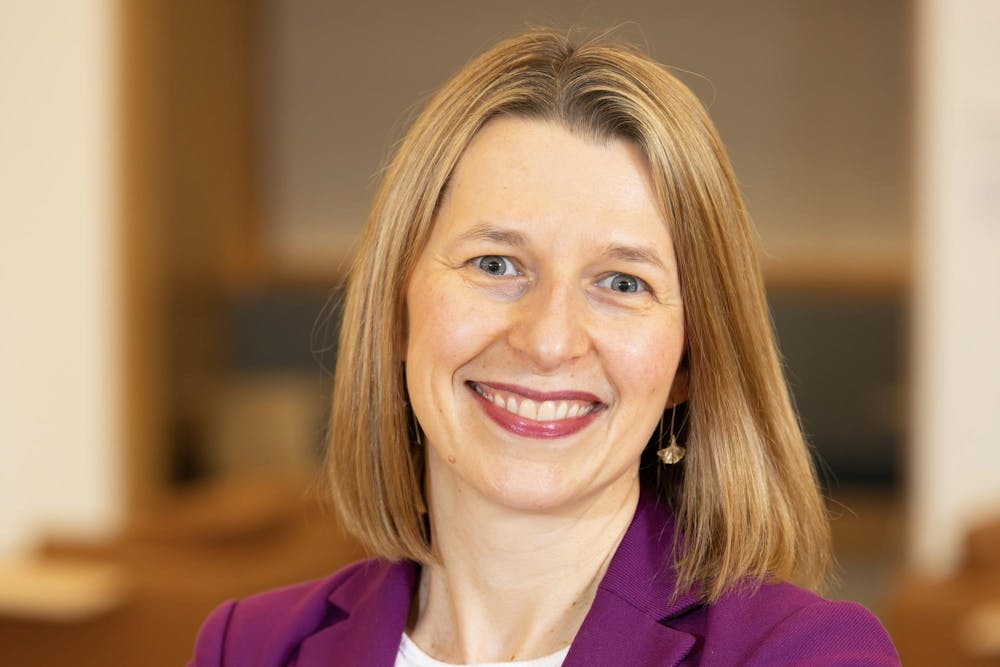
The Board of Visitors named Jeri Seidman, associate professor of Commerce and outgoing Faculty Senate chair, as the new faculty representative to the Board April 16. Seidman’s position begins July 1, and increasing trust between the Board and the University community is Seidman’s primary goal during her term, she said.
“I [will] go into this year without a goal other than to rebuild relationships,” Seidman said.
In her role as faculty representative to the Board, Seidman is a non-voting member who provides the faculty perspective to Board members during open and closed sessions of meetings.
Seidman explained that in her role as Faculty Senate chair, she learned that the most beneficial practice included listening to a wide variety of voices to solicit a broad faculty perspective. She said she plans to exercise this same practice in her coming role to speak on behalf of faculty as the Board makes decisions.
Seidman emphasized that, from what she has seen, faculty currently feel they need to monitor the Board’s actions. She said that success at rebuilding trust between faculty and Board members will be evident when faculty no longer feel the need to do this. A few years ago, Seidman said, faculty were not tuned into who exactly was serving on the Board and when meetings were taking place. She said faculty simply trusted the Board to make proper decisions.
In her upcoming role, Seidman said she aims for faculty to have less anxiety and fewer questions when the Board meets and makes decisions. Over the past year, University constituents — including faculty — have spoken out against Board decisions and processes. Following the resignation of former University President Jim Ryan, and throughout the search for the University’s 10th permanent president, the Faculty Senate — under Seidman’s leadership as chair — passed resolutions calling the search process rushed and one that lacked community input.
“I would love to get back to that place where … there’s enough trust in the Board that … most faculty members don’t really pay attention to those meetings, and assume that the decisions that will be made will be ones that are made for what they also view as the best future for the University,” Seidman said.
Expanding on this idea, Seidman explained the Faculty Senate is made up of one senator from each University department and has a proportion system to allocate a certain number of senators to each of the University’s schools. She said this representation should allow faculty members to have trust in their leadership — both in the Faculty Senate, and ultimately, in the Board. The expectation of faculty members is that their senators have a working relationship with University administration and with Board members, she said.
“When the faculty broadly trust that the relationships between their elected representatives and the Board are happening — and the conversations are happening — and the input is being received as they hope, then the rest of the faculty doesn’t pay that much attention,” Seidman said. “It is assumed that the relationships are occurring at the [Faculty] Senate and the Board level, and not everyone else needs to stress about it.”
Further, Seidman acknowledged the need for the faculty representative during Board meetings because she said Board members in general do not hear from faculty and students on their own.
Many Board members are University alumni, and Seidman said that while they remember their time as a student, they were not involved in administrative decisions during that time. Now, as Board members, Seidman said their strongest connection to the University is through the administration which gives data to the Board for the purposes of decision making.
“My goal, and I think my role, is to make sure that [Board members] are also considering faculty and staff and students who are here, living out the [University] mission day in and day out … as [Board members] take the data that they're being given from the administration and make the decisions that they're charged with making,” Seidman said.
Seidman further noted that her role is not necessarily to cooperate with the Board. She said she hopes she does cooperate with them — and that she already has relationships with multiple Board members — but that her role, specifically, is to ensure faculty voices are heard.
Regarding her motivation to become faculty representative to the Board, Seidman explained that at least three faculty members are considered each year for the position. The Faculty Senate chair is automatically one of those three, so she said that when she agreed to stand for chair-elect in 2024, she was “essentially agreeing to be considered for the faculty representative in 2026.”
Ultimately, Seidman expressed her gratitude for the position and said she is looking forward to her role as faculty representative to the Board.
“I am honored that I was elected to continue to represent the faculty, and I appreciate that the Board trusted the faculty’s choice and accepted my selection,” Seidman said. “I have appreciated the conversations that I've had with Board members so far in my role as [Faculty] Senate chair, and I look forward to more conversations and more time with them.”

Lucia Gambacini is a senior writer on the news desk covering Student Council and other issues pertaining to student life and government. She is a third-year from Richmond, Va. studying Political & Social Thought in the College.
Read More
Allergy Clinic to close following accreditation review of Student Health and Wellness
By Ruby Budetti | 20 hours agoThe decision follows a review of SHW by the Accreditation Association for Ambulatory Health Care.

VERVE apartment set to bring 1,332 beds to Charlottesville market in summer 2027
By Edward Christopher | 20 hours agoThe building is replacing nine residential buildings in the area, which is adjacent to Grounds and 0.6 miles from U.Va. Health.
Lecture hosted by Rare Book School reframes the newspaper as an industrial product
By Vrinda Vashisht | YesterdayStamm argued that the 20th century newspaper was not only a vehicle for journalism, but also a manufactured product of industrial capitalism.