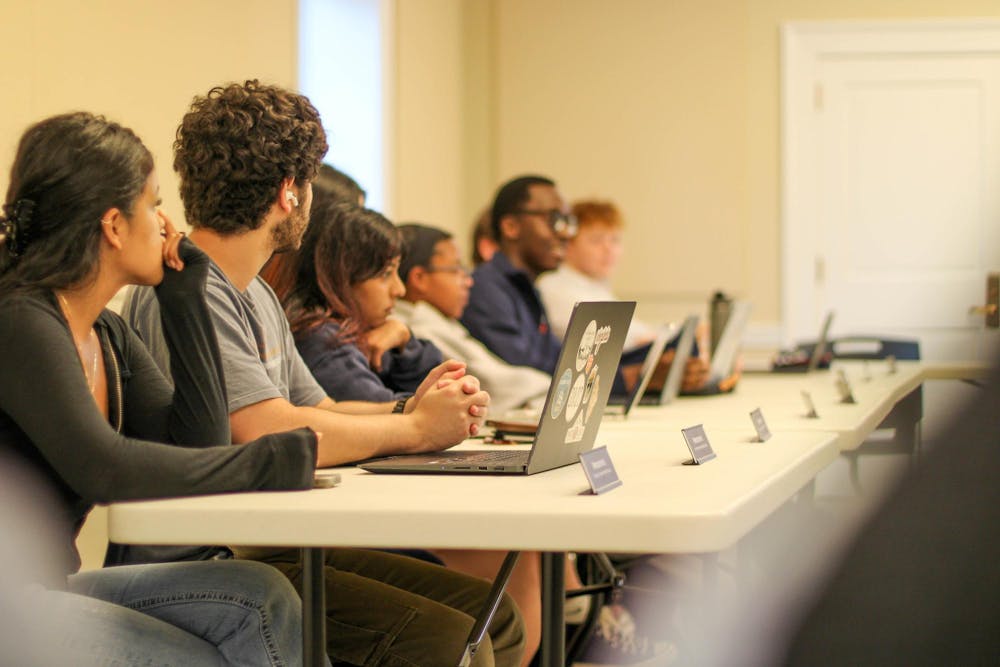
Student Council convened Tuesday for its final meeting of the spring semester via Zoom to officially swear in third-year Commerce student Michael Mitchell as Student Council president. Representatives also swore in third-year College student Saehee Pérez as Student Council vice president for administration and third-year Batten student Harper Tran as vice president for organizations. Third-year Architecture Rep. Philippe Hempel was also elected as the new chair of the representative body for the 2026-27 academic year.
Student Council previously postponed its leadership transition to an undetermined date amid the appeal of the 2026 Student Council presidential election filed by Micah Andrews, former Student Council presidential candidate, former chief of Support and Access Services and third-year College student.
Andrews alleged that the Inter-Fraternity Council engaged in bribery and coercion through a bar tab incentive intended to influence votes in favor of Mitchell. She also claimed that Mitchell violated Article III Section 3 of the University Board of Elections Rules and Regulations, which states that no candidate may ask an organization to become an endorsing organization nor become involved in the organization’s endorsement process.
Andrews first appealed the UBE’s initial decision that stated no violations had occurred. Following her appeal, the case was brought before the University Judicial Review Board, which determined that parts of the factual record required further development and returned the case to UBE for additional investigation.
After the JRB returned the appeal to UBE for another review March 20, Clay Dickerson, former Student Council president and fourth-year College student, announced March 24 that the Executive Board voted to postpone Student Council’s March 29 leadership transition to an undetermined date due to the Student Council presidential election appeal process. Due to the ongoing appeal process and decision to postpone the transition, Student Council did not convene for approximately four weeks during the appeal process.
Under the Student Council constitution, leadership transitions must occur within 30 to 60 days following elections. The Constitution also states that the Executive Board has discretion to set the transition date within that 30- to 60- day timeframe following the conclusion of spring elections — which took place Feb. 24-26. Accordingly, Student Council transitioned Monday — 60 days after the end of the spring election period.
During this period, UBE issued a 2-1 decision reaffirming Mitchell as Student Council president. The case was subsequently appealed by Andrews to the JRB. The JRB then released its decision Monday, upholding the results of the 2026 Student Council presidential election, reaffirming Mitchell as Student Council president.
Following the JRB’s Monday decision, The Cavalier Daily filed a Freedom of Information Act request for the JRB decision document. The FOIA Office of the University Counsel did not fulfill this request, citing Virginia Code § 2.2-3705.4(1), which exempts scholastic records containing identifiable student information from public disclosure, as well as the Family Educational Rights and Privacy Act, 20 U.S.C. § 1232g, which protects the privacy of student education records.
During Tuesday’s meeting, Mitchell said that he is eager to begin his term and engage with representatives in the coming year.
“I’m really looking forward to getting to know each and every single one of [the representatives] … I know this past month has been a little chaotic, but it is all completely resolved now, so we are very excited to hit the ground running and to get things done,” Mitchell said.
During the meeting, Imane Akhanous, former chair of the representative body and fourth-year College student, announced that she plans to form a committee to investigate the UBE processes in the most recent spring election cycle. She cited concerns that extend beyond the recent 2026 Student Council president election appeal, including questions regarding the integrity and enforcement of UBE’s election procedures.
“This doesn’t just stem from the presidential election,” Akhanous said. “It also stems from a long history of the UBE failing to put people on the ballot and not fully [ensuring] that the students that are putting themselves on the ballot are actually representing the school they say they’re from.”
Mitchell also addressed questions from representatives regarding the Student Council’s summer budget — which is typically developed, reviewed and passed through the representative body before the end of the spring semester. Under the Student Council’s bylaws, the summer budget process begins in the spring semester following the transition into the new administration, with Executive Board members and directors within their respective branches meeting to develop funding proposals. These proposals are then reviewed internally before being sent to the representative body for approval. However, representatives have noted that this year’s timeline has been disrupted by the postponed transition and delays in leadership onboarding.
According to representatives, the postponement created a compressed timeline for developing and approving both the summer budget and annual budget allocations — which under normal circumstances would already be underway during the spring semester.
The summer budget is typically developed in the spring semester after the new administration takes office and begins the first day of summer recess until the annual budget is approved. The annual budget process begins months before it is proposed to and approved by the representative body at the beginning of the fall semester for the academic year. The annual budget must also be approved by the Student Activities Committee.
In response to a question from Akhanous about the budget timeline, Mitchell noted that the timeline is contingent on the president’s appointment of the remaining Executive Board positions — including the chief of Support and Access Services, chief of Cabinet, director of University Relations and chief of Coalitions.
Mitchell said that invitations to the selected individuals for Executive Board positions were sent Wednesday, with a 24-hour window for acceptance. Selections have been finalized but still require approval by the representative body before Student Council can advance with legislation for the summer budget.
Mitchell further explained that additional summer sessions will be necessary to approve the appointments and pass the budget legislation, though those dates have not been set yet. He added that, based on his discussion with SAC, most summer spending typically does not begin until July. However, he expressed that he would prefer the legislation for the summer budget to be passed as soon as possible — ideally in May.
In addition to discussing the current state of the transition process, Hempel was also sworn in as the new chair for the representative body after representatives conducted elections in a closed session. According to Student Council’s bylaws, the chair of the representative body presides over meetings of the legislative body, maintains order, recognizes speakers and ensures that the legislative process is conducted in accordance with governing documents.
Representatives also passed a bill sponsored by Tran that approved 43 new Contracted Independent Organizations. According to Mitchell, each organization had been jointly vetted by the Student Council’s Organizations Recognition Committee and Appropriations Committee and Student Engagement to ensure all structural requirements were met. Tran noted that five CIOs still need to be vetted by Student Engagement and were therefore excluded from the bill. She said that the five CIOs will likely be voted on during the summer sessions.
Student organizations seeking CIO status must meet specific criteria set by the University and Student Council — including having at least 10 members, ensuring officers are fee-paying students, maintaining a constitution on file, signing the CIO agreement, adopting the non-discrimination policy and demonstrating sustainability through an operational plan.
During leadership reports, second-year Commerce Representative Hayden Matay also provided a brief update on the ongoing University-wide survey examining club culture and recruitment processes within student organizations. A new version of the survey was released April 8 and distributed to all undergraduate students through Class Council Listservs via email. The updated survey was developed in collaboration with Student Council’s Data Science Committee based on feedback from the initial release of the survey.
According to Matay, the new version of the survey has received approximately 700 responses and he further encouraged representatives to complete the survey and help further circulate it among the student body.
“I've been working on an initiative to hopefully improve club culture at the [University] in any way that we can, specifically club recruitment,” Matay said. “I'd love to hear your guys' voices as people that are extremely engaged [in Student Council].”
Student Council will convene during summer sessions to pass its budget legislation. Representatives will also formally convene Aug. 25 for their next weekly general body meeting.
Read More

Office of Engagement hosts Lori McMahon to discuss research at the University
By Isabela Delgado | 15 hours agoThe University’s Office of Engagement, housed within the External Relations office, hosted their final webinar of the semester in their “Leader to Leader — Insights from U.Va. Leadership” series Wednesday which featured Lori McMahon, University vice president for research and professor of Neuroscience.

Iranian international students face visa challenges amidst national policy shifts
By Michael Racz | 3 days agoAccording to representatives from the International Studies Office, the ban on issuing student visas is prompting many students to consider extending their studies at the University to remain in the United States.

Honor Committee holds its final meeting of the 2025-26 academic year
By Isabela Delgado | 3 days agoThe Honor Committee met Sunday for its final meeting of the 2025-26 academic year to discuss a recommendation of how to handle student unresponsiveness after students are notified of an alleged violation of the University’s honor code.