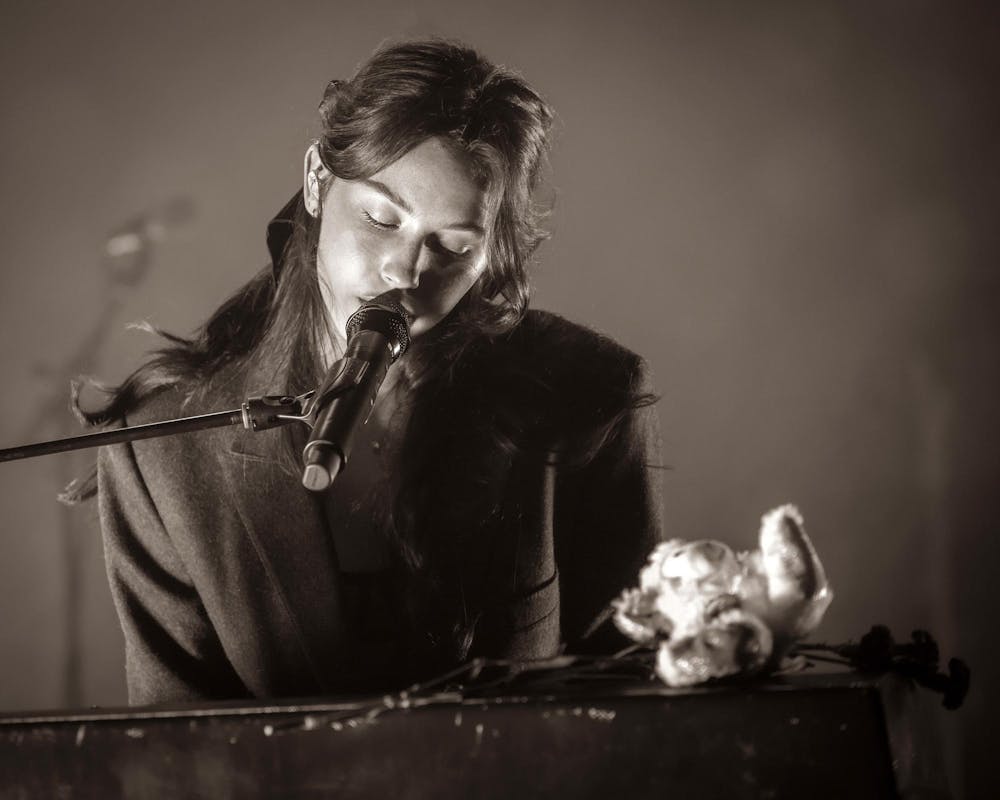
Since breaking into the mainstream with the release of “The Secret of Us” in 2024, singer-songwriter Gracie Abrams has become one of pop’s most recognizable voices for her emotionally raw songwriting, soft vocals and quiet vulnerability. “Daughter from Hell” released July 17, serving as Abrams’ third studio album, following “Good Riddance” in 2023 and “The Secret of Us” — containing her hit songs “That’s So True” and “I Love You, I’m Sorry.” Abrams also recently announced “The Look at My Life Tour,” which will begin during winter of 2026.
On “Daughter from Hell,” Abrams continues to lean into her intimate songwriting and whispery vocals while expanding toward a grander, rock-influenced sound. With 16 songs and a 56-minute run time, the singer pairs her signature sound with electric guitars, synths and broader orchestration to reflect on her emotionally turbulent teenage years and transition into early adulthood. Abrams built anticipation for the album through the release of two singles earlier this summer, “Hit the Wall” and “Look at My Life.”
Frequent collaborator Aaron Dessner — founding member of indie rock band The National — returned for the project as Abrams' primary producer and co-writer, once again shaping an understated yet expansive sound. Although the album represents Abrams’ boldest sonic evolution to date, her confessional, vulnerable lyrics revisit overly familiar, repetitive themes of anxiety and introspection.
On the introductory track, titled “Hit the Wall,” Abrams opens with faint, shaky vocals before gradually layering harmonies as the song progresses, mirroring the emotional unraveling described in lyrics like “I live in a pattern of breakdowns.” Although she effectively captures feelings of emotional collapse, metaphors such as “I’m not a problem you can solve” feel comparatively surface level, lacking the lyrical depth found elsewhere on the album.
After “Hit the Wall,” the second track “Death Wish” slows the album’s pace with a gentle acoustic guitar that remains constant throughout its runtime, allowing Abrams’ vocals to take center stage. As the chorus builds to a crescendo with lines such as, “So how will it end? / How long will you give me? / 'Til you twist the knife with a smile while you kill me?” Abrams gradually transforms an understated acoustic ballad into an intense experience following a friend’s difficult relationship, foreshadowing the dynamic production that becomes increasingly prominent later on in the work.
“The Knife” follows as the third song and exemplifies this growing intensity, with an opening piano melody that expands into layered harmonies, belted vocals and faster-paced tempo. The song’s shifting arrangement mirrors its conflict — Abrams ruminating on lasting post-breakup pain — as she repeatedly insists, “This should be the last time,” only to close the track with the contradictory statement of “This won’t be the last time.” While the repetitive chorus occasionally weakens the song’s momentum, its gradual escalation serves as a clear example of Abrams pairing intimate songwriting with a more ambitious, rock-influenced sound.
That evolution arguably reaches its strongest point on the album’s title track, “Daughter from Hell.” Opening with distorted electric guitars that immediately contrast Abrams’ characteristically soft vocals, the song gradually broadens its sound as shimmering harmonies and synth-pop textures accumulate with each repeated chorus. The isolated vocals of the opening refrain — “I want your grace / I want your sugar / And I want to say / How much I owe ya / I’ve loved your shoulder” — place Abrams’ vulnerability at the forefront before the fuller instrumentation arrives.
The song concludes with the lines, “Daughter from hell but I came around / I’ll try to become you now,” framing the album’s title as an expression of remorse. During an appearance on “The Tonight Show,” Abrams described the song as “a decades overdue apology” to her mother for being turbulent in her youth. Both its bold production and personal reflection create some of the project’s most emotionally and artistically mature moments.
The pace of the album picks up with “Look at My Life,” one of the more catchy, sing-along style tracks. The fast cadence and bright instrumentation contrast sharply with lyrics expressing self-doubt and anxiety, including phrases such as “Do I look high-functioning or / Is my façade crumbling?”. While the juxtaposition between upbeat production and vulnerable lyricism is compelling, other lines such as “I’ll move across the country just to judge myself” and “Hope I don’t crash and blow out the headlights” rely heavily on hyperbole, occasionally undermining the emotional maturity displayed in other lyrics.
However, “Good Reason” regains some emotional nuance with an acoustic guitar and repeated phrases of “If only I had a good reason” and “If only you didn’t adore me,” reflecting Abrams’ rumination after ending a relationship for no concrete reason. Instead of portraying heartbreak as a dramatic, central conflict, she explores the quieter guilt of choosing herself over someone else, allowing the soft production and repetitive lyrical phrasing to mirror her inability to move on.
Later tracks continue experimenting with both sound production and lyrical perspective. Co-written with singer-songwriter and longtime friend Audrey Hobert, “Minibar” shifts toward a brighter pop sound while using the setting of a party to explore similar themes of anxiety and emotional isolation through lines such as “I feel weird, I think I’m gonna go” and “and they’re loud, I’m mellow.”
Meanwhile, her collaboration featuring Marcus Mumford, “What If It’s Right?” explores two lovers in conversation as they question whether ending their relationship is the right decision. Their harmonized refrain, “This could be the wrong thing / But what if it’s right?” emphasizes their mutual uncertainty, while echoing themes of miscommunication explored in several other contemporary duet ballads, such as Taylor Swift’s “exile” with Bon Iver or “coney island” featuring The National.
“Daughter from Hell” demonstrates Abrams’ most ambitious sonic evolution, pairing her trademark intimacy with atmospheric, arena-ready production. While the album hints at a broader artistic direction through its expanded instrumentation, its repetitive lyrical themes and familiar introspection keep it from feeling like a true reinvention. Instead, the project finds Abrams cautiously testing the waters of a bolder sound, suggesting an artist on the verge of growth rather than one who has fully taken that leap.
Read More

Hoo’s Watching: Hoo's in love? Movies that capture summer romance
By Victor-Jenay Cortijo Lopez | 21 hours agoTogether, these three films explore first love, self-discovery and fleeting connection, illustrating how romances that last only a season can leave lasting emotional impressions.

Disney's live-action ‘Moana’ fails to go far with audiences
By Carly Smith | 2 days agoThe live-action remake of this beloved film was released July 10, starring newcomer Catherine Laga’aia as Moana and Dwayne “the Rock” Johnson reprising his role as Maui.

SugarBear Ice Cream: A sweet addition to Charlottesville's food scene
By Lucy Larsen | 4 days agoIn a city famous for what is on the menu, SugarBear convinced me to save room for dessert.