
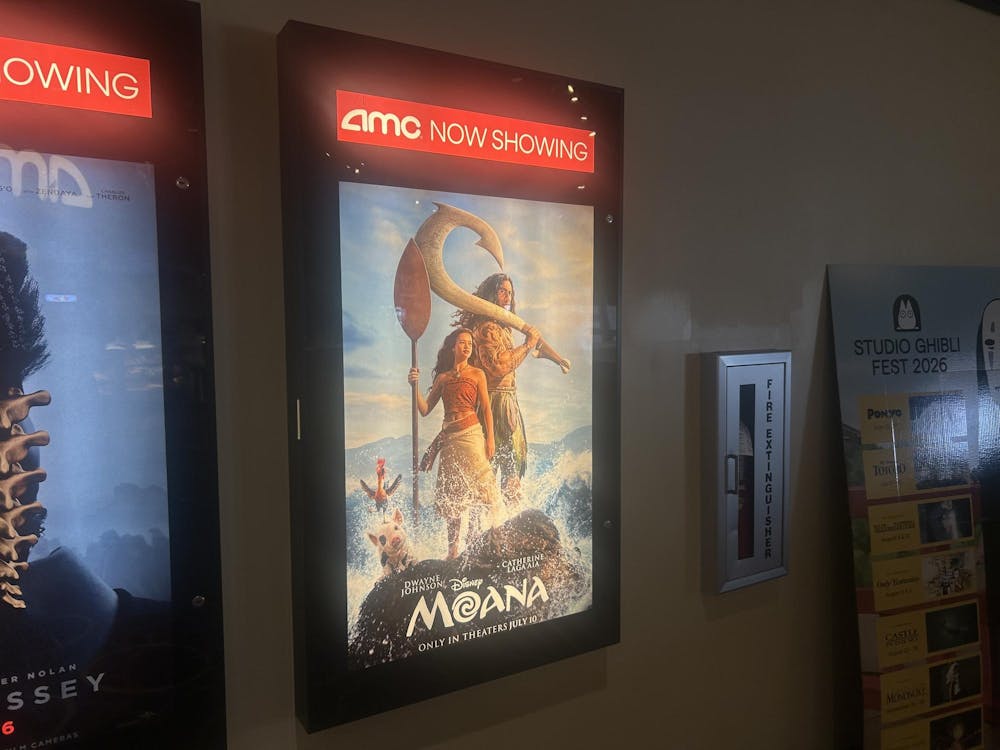
Disney’s “Moana” captured the hearts of adults and children alike in 2016, taking viewers on the Polynesian princess’ journey beyond her family’s island to find the demigod Maui and restore the heart of Te Fiti, a mystical deity who endows the land with its natural beauty and prosperity. With catchy, emotionally-driven songs like “How Far I’ll Go” and “You’re Welcome” written by Lin-Manuel Miranda, Moana became a staple in the Disney Princess legacy. The live-action remake of this beloved film was released July 10, starring newcomer Catherine Laga’aia as Moana and Dwayne “the Rock” Johnson reprising his role as Maui.
Unlike the animated version, the live-action film is directed by Thomas Kail, but many members of the animated film’s original team returned for this new adaptation. Auli’i Cravalho, who voiced Moana in the animated film, served as an executive producer on the remake, with Johnson and Miranda both acting as producers. In directing “Moana,” Kail reprised his working relationship with Miranda after directing the 2020 movie version of “Hamilton.”
The movie opens identically to the animated film, with Moana’s grandmother, Gramma Tala — played by Rena Owens — telling the story of Maui stealing the heart of Te Fiti to the children in their village, Motunui. As viewers learn from the movie, after Maui stole the heart, the landscape of the surrounding islands began to struggle, eventually leaving Moana’s village with no food or crops and providing Moana her incentive to go on the adventure. The first character that viewers see is Maui, with flowing locks of dark, curly hair and a body covered in tattoos — a look jarringly different and, frankly, unsettling from Johnson’s typical bald hairdo and classy style. The beginning of the film also includes the same slow songs as the previous movie — “Tulou Tagaloa” and “An Innocent Warrior” — introducing viewers to Moana’s culture and village.
”Where You Are” is the first song in which audiences see the 19-year-old Australian actress in her titular role. Wearing Moana’s classic burnt orange and cream outfit, Laga’aia conveys the character’s strength, internal conflict and wide range of emotions throughout her journey of self-discovery over the course of the movie. In the scene where Gramma Tala dies, Laga’aia and Owens’ acting is moving, with an emotional goodbye that demonstrates the strong bond between grandmother and granddaughter. Laga’aia also provides strong vocal performances, sounding almost identical to Cravalho.
Not only does Laga’aia live up to the character’s animated screen presence, but she and Johnson also replicate Moana and Maui’s chaotic interpersonal dynamic. As in the original film, the two characters are playful with each other, pushing one another off the sailboat that Moana takes on her adventure and exchanging smart, quick-witted banter with one another. The characters stay true to their original iterations as Laga’aia establishes Moana’s stubborn and insistent nature, contrasting with Johnson’s portrayal of Maui’s arrogance and carelessness.
The setting is also consistent with the original film, and the small details, textures and bright colors used throughout allow the village of Motunui to truly come to life. Moana and her family walk through vibrant green grasses, villagers are seen with hot pink and orange flowers placed in their hair and the ocean catches viewers’ attention with its teal and bright blue color.
Moreover, the film’s creators use the ocean as a symbol to convey emotion. Whenever Moana feels upset or uncertain, the sky and ocean are a dark, dull blue. However, in uplifting, empowering moments such as “How Far I’ll Go,” the sky is a bright blue, with the ocean matching that positive hue. During Moana’s lowest point in the movie — when she is about to give up on her journey — the ghost of Gramma Tala comes to support Moana, bringing with her white stingray ghosts in the ocean. The contrast between the dark ocean and white specters is beautiful, especially supported by Laga’aia singing the iconic line “I am Moana” in the song “I am Moana (Song of the Ancestors).”
Despite some visually appealing symbolic aspects, the movie tends to simply go through the motions in terms of its plot and filmmaking. The cartoon version provided a scene-by-scene roadmap for telling the story and the filmmakers seemed to follow it almost exactly in the latest rendition. Compared to the animated film, the interpretation of the landscape and its inhabitants — ranging from the giant coconut crab Tamatoa to Te Fiti herself — feel insignificant and devoid of creativity, dragging the movie down in terms of its engagement and ultimately influencing the pacing.
Miranda wrote an additional song for the new film, “Along the Way,” which was featured in the movie’s ending credits. This new track is about hope and, as evident from the title, finding one’s “way” in the world. With lyrics such as “Find your way, your horizon / Find solace on the surface of the sea / Race the day, find your island / You're answering the call, and you are free,” Miranda sends an inspirational message to audiences. The song also has a light, upbeat, fast drum sound, which acts as a positive final note for the film.
Nonetheless, the lack of new songs within the actual runtime of the movie causes the film to feel like an unoriginal rehash of a 10-year-old story. In many Disney live-action remakes — such as “Snow White” and “Beauty and the Beast” — the lead characters sing new songs written specifically for the remake, making the movies slightly different from their original versions.
Not only are the musical components distinct, but in previous live-action adaptations, the appearance of the characters themselves are often unique relative to their original counterparts. In 2017’s “Beauty and the Beast” starring Emma Watson, Belle’s village attire is slightly different, with the costume designers layering different materials and adding colors to the traditional blue and white frock. Furthermore, the anthropomorphic candelabra and clock used for Lumiere and Cogsworth, respectively, are intricate and ornate, differing from the more simplistic designs in the 1991 cartoon. Filmmakers have also further developed a story’s plot in new renditions. In the 2015 remake “Cinderella,” the relationship and storyline with Cinderella and her mother is explained and shown to the audience — an aspect that was absent from the original film.
In recent years, live-action adaptations have not done well at the box office, with viewers feeling unimpressed with modern remakes. This shortage of new material may be a major drawback to the success of “Moana,” with the opening only reaching $43 million in North America as compared to the projected opening of over $60 million. Moreover, the movie had a $250 million production budget, making these low numbers even more alarming.
The live-action remake of “Moana” brings audiences back to the island of Motunui, retelling the beloved story of the Polynesian princess. However, this new adaptation almost exactly mirrors the 2016 animated version, causing the new creation to lack real purpose. With respect to visuals and acting, the remake is a beautiful depiction of the world of Moana, but what did not go “far” was the originality.
Read More

Le Marché du Soleil stitches together a community, rain or shine
By Nritho Halima | YesterdayThe event marked the fourth collaboration between Le Marché du Soleil, a vintage and secondhand pop-up shop and Cou Cou Rachou, a Charlottesville bakery known for its close-knit local following.
The Southern’s showcase reintroduced student bands on the right note
By Kelsey McIntyre | 2 days agoThe Southern’s concert presented a moment for bands to come together and perform in front of an audience of dedicated music lovers.

Hoo’s Watching: Fall films to embrace the autumn spirit
By Bridget Baile | 4 days agoHere are three essential watches for any reader as they prepare to witness the leaves outside their windows change from green to orange.


