
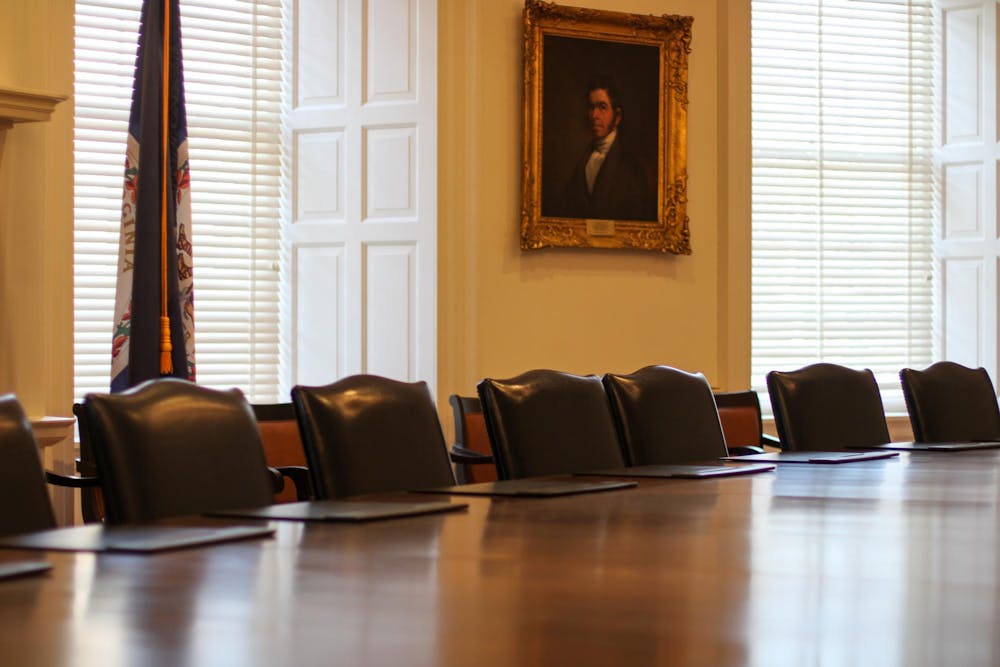
Class of 2026 alumnus Gregory Perryman began his role as student representative to the Board of Visitors June 1, 2025, and completed his term this past June.
In the intervening year, the University underwent a series of administrative changes, including the resignation of Jim Ryan, former University president and School of Law professor — less than four weeks into Perryman’s term. In the following months, the Board selected University President Scott Beardsley Dec. 19, and Gov. Abigail Spanberger (D) appointed 10 new Board members Jan. 17. Ultimately, over the course of his term, Perryman worked with 30 Board members, three Board rectors and four University presidents — one of whom was an acting and one of whom was an interim president.
The student member of the Board is a nonvoting role that involves attending Board meetings to communicate and advocate students’ opinions and interests to the Board. The term lasts one year, and rising fourth-year College student Jackson Sleadd began his term as student member of the Board June 1.
Perryman expressed his belief that it was particularly important, given the administrative changes, to consistently make students’ concerns known to the Board. He said that he found that regardless of the makeup of the Board, his role remained the same — being an unabashed, clear and collaborative voice representing students.
“I got to work with a lot of different people, and what I found was that regardless of who was on the Board — whether they were appointed by a Democrat or a Republican — the … work of the student representative doesn't change,” Perryman said. “I think it was pretty cool because even with a lot of change in the Board, I was consistent … The single most important job of the student member is to … be there and to voice the perspectives of students.”
He also discussed his belief in the power of the student representative to impact the decision making process of the Board, despite not having voting power. According to Perryman, the University student representative is able to be in the room for closed session Board meetings, something he said is unique among student representatives at other public universities in Virginia.
The student representatives to the Boards of Visitors at Virginia Tech, James Madison University and William & Mary all serve one-year terms and are nonvoting members. According to the 2025-26 Handbook for Student Representatives to the Virginia Tech Board of Visitors, only the 14 voting members of the Board are present for “closed-session meetings,” and representatives from constituent groups, including students and staff, are not allowed.
Similarly, at James Madison University, according to the Board of Visitors Manual, the student representative is “not authorized” to attend closed meetings. However, the student representative to the William & Mary Board of Visitors has the same right as the University student representative to attend closed meetings, according to the Board’s bylaws.
“[Being allowed at closed sessions] allowed me to be very effective in having those candid conversations around some of the most … sensitive issues that were required by law to be discussed in a closed session,” Perryman said.
During both closed and open sessions of Board meetings, Perryman said that he consistently felt respected by the other Board members. However, he also said that it was evident to him that many students felt that the Board was neither listening to them nor respecting them. He said that he made these concerns clear to the Board and encouraged its members to take steps to mend those feelings of distrust with the student body.
“We were facing a lot of turbulent challenges over the past year regarding … leadership transitions and scrutiny from the federal government,” Perryman said. “I was always focused on making sure that the Board knew that students — a lot of students — did feel like they weren't being listened to … Oftentimes over the past year, the Board fell short … and it was a really difficult task to try to move the University in a direction where students did feel like the Board was listening to them.”
Reflecting on his term, Perryman cited the presidential leadership transition and the investigations by the Justice Department as the most difficult challenges that the Board faced. The presidential search committee embarked on a five-month search for the University’s 10th president beginning in mid-summer of 2025, and ended in December with the appointment of Beardsley.
Perryman recalled helping host six University-organized listening sessions as a member of the presidential search committee. The sessions were held in pursuit of gathering opinions from students on what they would like to see in their next president, with Perryman and several other Board members in attendance. Perryman said it was a pleasure to be able to hear from hundreds of students on the subject and relay their thoughts directly to the Board.
He remembered students telling him that they wanted a president who would continue to champion access and affordability for first generation students, was dedicated to public service and could protect the University from “political interference.”
While no longer on the Board, Perryman said that he believes the current members are thinking seriously about how to improve presidential searches going forward. During the presidential search last summer and fall, many University-affiliated groups spoke out against the composition and actions of the search committee, claiming it did not properly consider student and faculty input.
“I think ways [a search] could be improved in the future is to be cautious about pursuing major leadership searches and decisions while there's a fundamental lack of trust that's been expressed by key groups in the University community, like students and faculty and staff,” Perryman said.
Perryman said he is excited that, after the controversial search during the past year, students are becoming more interested in voicing their opinion on searches to fill University leadership vacancies. He added that he would like to see the University administration make the effort to have clear communication with students on the ongoing searches, to the extent that it is possible.
The University is currently conducting searches to fill the positions of deans of the School of Architecture and the School of Medicine, associate dean for graduate programs in the School of Nursing and associate dean for administration in the Frank Batten School of Leadership and Public Policy. The University announced that it had paused its search for the executive vice president and provost in March but in a media release Thursday, University Spokesperson Bethanie Glover announced the search was relaunched with a newly constituted search committee.
Perryman said that he emphasized the importance of listening to students’ concerns in his closing remarks to the Board at the April 16 meeting, which was the final meeting of his term.
“I mentioned … that the Board should always heed the student voice … and should always endeavor to listen and understand students' preferences and passions and concerns, because the Board cannot be successful otherwise,” Perryman said.
In sum, Perryman said he is most proud of helping to build connections between students, other members of the University community and Board members — connections that he said he believes were vital in helping the University recover from the challenges of the past year and build back stronger for the future.
Perryman said he believes the challenges of the past year did not weaken the University community, but did create general feelings of anxiety, making it difficult for the community to look towards the future. Now, Perryman said he believes the University can begin looking forward again.
“It significantly affected our ability to be forward-thinking and collaborative and united about what kind of University we want to be,” Perryman said. “Looking forward, there's a great opportunity to do just that.”
Perryman said he believes that within the past year, more attention than ever was paid to the Board. He added that because of this heightened awareness, he hopes students may be inspired to engage more with the decision-making process of the Board. He suggested that if students believe having a voting student member would lead to better governance, they should work to express that to the Virginia General Assembly.
“If students just come together, organize themselves and articulate what they want from their University, so much can happen,” Perryman said.

Abigail Larkin is a staff writer on the news desk. She is a third-year student in the Batten School of Public Policy, majoring in public policy and foreign affairs. Abigail is from Norfolk, Va., and she enjoys writing about state and national politics.
Read More

The Cavalier Daily joins amicus brief supporting student press at University of Alabama
By Jaylynn Perez | 25 minutes agoThe Cavalier Daily joined 39 other collegiate news organizations and 15 student editors from across the country in signing an amicus brief Sept. 2.

Student Council considers creating an ad hoc committee to review UBE proceedings
By Lucia Gambacini | 14 hours agoConsideration of the bill was postponed until the next general body meeting.

Health System Board Finance Working Group passes remote participation policy
By Lily Kostro | 15 hours agoThe policy states that a member of HSB may participate remotely in meetings not open to the public, provided the member notifies the rector that they are unable to attend in-person due to an emergency, personal matters or a disability.


