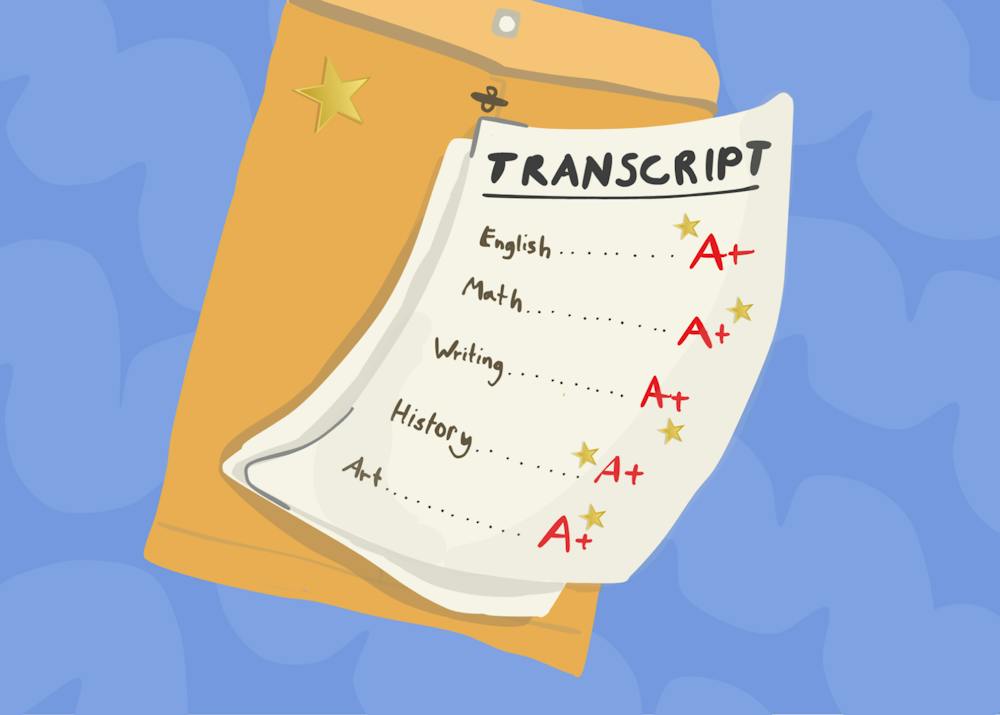
If you are interested in law school, it is probable that you have been told to take the courses that will maximize your GPA. In August of this year, the School of Law welcomed a class with a median GPA of 3.99. But many students, regardless of their majors or intended careers, have an understanding that it is in their best interest to minimize challenging coursework to achieve a higher GPA. After all, future employers and graduate school admissions teams may look to that one number to predict future outcomes in higher-level courses and the workplace.
Grade inflation has been the discussion of universities and politicians alike in recent months, with schools like Harvard University embracing caps on the number of students who can receive A grades. The University is not an outlier in this regard — its average GPA has risen from 3.24 to 3.61 in the last 15 years, mirroring national trends. This shift is still incredibly significant — when average GPAs shift closer to an A or A-minus, it becomes harder to know what a given GPA reveals about a student’s performance or the rigor of the work behind it. Unsurprisingly, this raises questions about rigor and the point of higher education. Have classes really become easier? Has the university degree become a transactional stop on the path towards professional attainment?
The central problem, however, is not just that grades mean less, or that there will be no basis for comparison between students. Indeed, some professors report that, although students receive higher grades on average, there is still sufficient range for determining top performers. Rather, the problem is that student behaviors and interests will rationally adapt to meet the numerical demands of application processes. When a high GPA is deemed important for future opportunities, students have more reason to avoid difficult courses, choose classes based on their expected grades and protect their transcripts, rather than pursue what genuinely interests them.
Students — and I have certainly, at times, been among them — have learned to treat course selection as a form of risk management. Some fill credits with “GPA boosters” and seek out courses with lenient grading policies. I have been tempted to switch out of classes I find interesting if I know they may cause a drop in my GPA, and I have looked at theCourseForum to see grade distributions and weigh the risk against my degree of interest in the subject. None of these decisions feel particularly dramatic in the moment, but they reveal an alarming pattern of protecting professional advantage over valuing genuine educational challenges.
In these circumstances, curiosity can become a liability, wherein taking a class in a new discipline, improving upon a subject you struggle with or simply trying to challenge yourself becomes not merely a question of learning, but of transcript preservation. Rigor and exploration become secondary to maintaining a perfect record. Further, though inflation may, in theory, lower student stress, the sense of failure when even B grades are received is apt to perpetuate perfectionist anxiety.
There is a saying that “As goes Harvard, so goes the nation.” However, while Harvard’s impulse to reduce the impacts of grade inflation was correct, grade caps miss the point. They drive us to rank ourselves, rather than establish clear standards of rigor, and create intense stress and fewer competitive advantages post-graduation — factors that contributed to the system’s ultimate failure at Princeton University in 2014. There are certainly better alternative methods.
It would be far too great a task to entirely uproot the current significance of grades in career and educational prospects, but we can try to contextualize them and improve standardization. For instance, we can begin placing percentiles alongside grades on transcripts, reducing the impact of the “A-minus cliff,” which creates vast GPA differences along fairly arbitrary cut-offs. A student who earns an A-minus rather than an A may be separated from a classmate by only a few points, but that distinction can compound over dozens of courses and ultimately have consequences for scholarships, graduate school admissions or employment.
We could also normalize grades across departments, reducing discrepancies between departments, so that students are not penalized for taking courses in disciplines where high grades are less common. Perhaps we also need to reconsider the system of student evaluations, which significantly affects faculty tenure and career prospects. Grade inflation and course evaluations are closely linked. When professors know that difficult grading can lead to poor evaluations, there is a structural incentive to make courses — and the resulting grades — more accommodating.
None of this is to say that the students or professors are at fault — they are working within a system defined by rigid standards and career risks. But we should all work to find the best, most honest way to amend it. The primary goal should not be to protect the reputation of the A grade or the University itself. Nor should the goal be to create another system for ranking students. It should be to give students something more valuable — the freedom to be curious, to struggle and to take intellectual risks without calculating what they will cost us.
Grace Clippinger is a senior opinion columnist who writes about politics for The Cavalier Daily. She can be reached at opinion@cavalierdaily.com.
The opinions represented in this column are not necessarily those of The Cavalier Daily. Columns represent the views of the authors alone.
Read More

GARVIE: Do not let data center development fly under the radar
By Adeline Garvie | 3 days agoThere is a new power-sucking facility being built less than two miles from you, and you may not even be aware of it.

EDITORIAL: College sports need fixing
By Editorial Board | 4 days agoCollege sports, in their current state, are fundamentally broken, and they desperately need legislative stabilization and reform.
EDITORIAL: Student self-governance deserves our confidence
By Editorial Board | September 19, 2026Now, just a month into the semester, new officeholders appear to be delivering results.