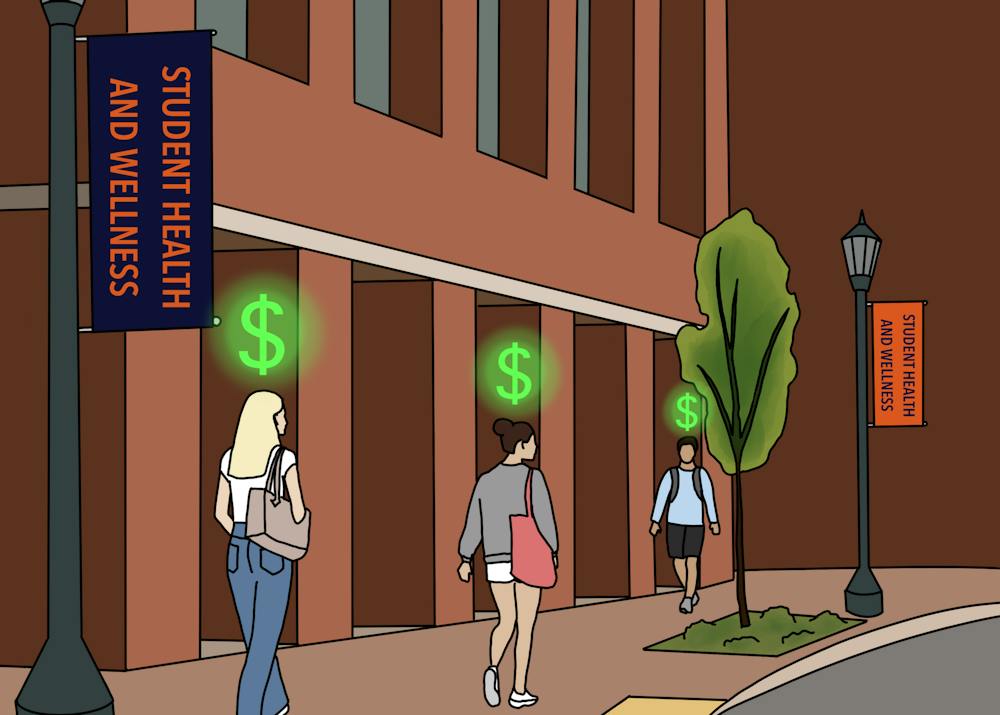
The University Board of Visitors approved tuition and fees for the 2026-27 academic year in April, and the Student Health fee rose from $1,147 to $1,184 per student.
The Board reviews tuition and fees annually and is responsible for the “long-term planning at the University,” according to its website. In a statement to The Cavalier Daily, University Spokesperson Bethanie Glover wrote that annual fee adjustments reflect the University’s commitment to keeping low costs for students and families, maintaining the quality of a University education and addressing growing operation costs.
Glover also wrote that the Student Health Fee supports the services and infrastructure required to provide services at the Student Health and Wellness Center. The Student Health Fee is different from the Student Health Plan — the default University health insurance plan for students who do not have their own.
“[The fee] includes visits with physicians, nurse practitioners, mental health clinicians and health educators,” Glover wrote.
The pricing section of the SHW website states that students do not have to pay or have insurance to cover professional services at SHW because of the fee paid with tuition, so there is no charge for evaluations or management services provided during visits with physicians, nurse practitioners, mental health clinicians or health educators.
According to Glover, some services offered at SHW are not covered by the Student Health Fee. The website lists the services that students must pay for at SHW, such as various immunizations, services, medical supplies, injectable medications and labs, along with costs associated with external referrals to care outside of SHW.
According to the SHW website, there are around 151,000 student visits to SHW each academic year, and 52 percent of students have used an SHW service. While clinician visits are covered by the Student Health Fee, Danielle D’Andrea, director of SHW Marketing and Communications, said there is not a way to calculate the number of visits per year that incur extra costs.
According to the SHW website, students are responsible for knowing what their insurance plan covers and informing their providers about concerns “prior to the receipt of services in question.”
The Student Charges section of the SHW website states that a $40 fee may be applied if a student is late or misses their appointment.
Students are able to view their statements on the HealthyHoos Patient Portal, and SHW offers educational events throughout the year to help students understand billing, according to Glover. There are also care managers in Medical Services and Counseling and Psychological Services, Glover wrote, who can help students navigate barriers to care, such as cost.
Glover also wrote that SHW offers a 24/7 After Hours and Emergency Services hotline that students can access after SHW operating hours if they have questions about if they need emergency care or where to seek medical attention.
According to the After Hours section of the SHW website, care providers are always on call and available for students to speak to about urgent medical concerns if SHW is closed. The website also states that students cannot ask administrative questions during after hours over the phone, like about insurance or to schedule or cancel appointments.
While SHW and U.Va. Health share some services and facilities, Glover wrote that none of the Student Health Fee “directly” supports U.Va. Health. Additionally, care at SHW is covered by the Student Health Fee and care at U.Va. Health is covered by a student’s health insurance.
“Student Health and Wellness does contract for some services from U.Va. Health that it does not operate in-house, such as X-ray imaging equipment and a U.Va. Health nutritionist,” Glover wrote. “Otherwise, the two groups operate independently.”
The SHW website states that SHW serves as a primary care provider, whereas the U.Va. Health Emergency Department or 911 should be contacted for severe and life-threatening situations.
Eric Swensen, U.Va. Health public information officer, said that students who are curious about the cost of a visit to U.Va. Health can visit its website for an out-of-pocket cost calculator and price estimates.
Glover clarified that students should refer to the SHW website when determining if they should seek care at SHW or through the U.Va. Health system.
Melody Yuan is a staff writer on the news desk. She is a second-year College student studying economics and statistics from Richmond.
Read More

Students, professors weigh in on the importance of letter grades
By Ruby Budetti | 10 minutes agoWhen thinking about letter grades for themselves, many University students and faculty said they prefer letter grading throughout all four years of college.

The ‘AI and Future of Work’ Series — How the University is preparing students for what is next
By Lidia Zur Muhlen | 2 hours agoIn a recent Gallup Inc poll, 79 percent of Americans believe that artificial intelligence will reduce the number of jobs over the next 10 years.

Tao Tan discusses financial future of U.Va., rising college tuition trend nationwide
By Lily Kostro | 21 hours agoTan explained how tuition costs will shape the future of academic institutions such as the University.