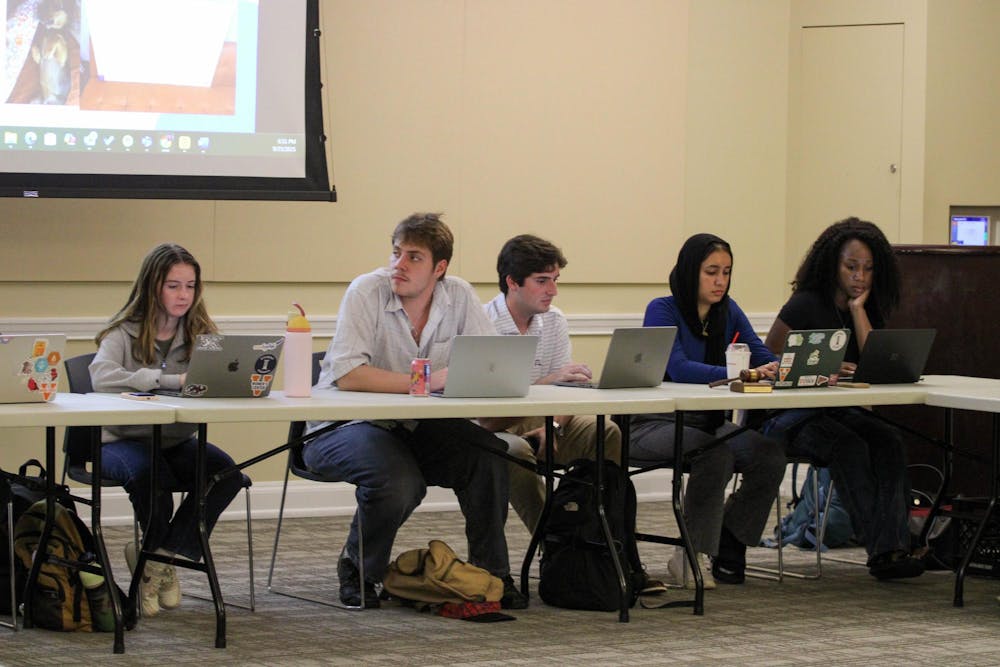
Student Council passed a bylaw amendment Tuesday changing how alleged violations of its Code of Ethics are handled, requiring review by the Rules and Ethics Board instead of automatic suspension. The amendment comes after concerns raised during the recent Student Council presidential election about fairness in campaign resources and how violations are handled.
The change follows a dispute during the Feb. 24-26 Student Council presidential election between Micah Andrews, Student Council chief of Support and Access Services and third-year College student, and Michael Mitchell, Student Council vice president for Organizations and third-year Commerce student, who won with 51.7 percent of the vote. Andrews raised concerns about inequities in campaign access after Mitchell used a restricted Contracted Independent Organizations listserv — which reaches leaders of more than 850 student organizations — to contact groups and solicit support for his campaign.
Student Council leaders said the situation exposed structural issues in how ethics violations are enforced, particularly given that the Rules and Ethics Board — which adjudicates such complaints — is not fully constituted and only has one member, despite being designed as a multi-member body.
In response, SB26-09 — titled ‘A Bill to Amend the Bylaws to Clarify the Enforcement Procedure of the Code of Ethics’ — was introduced by Imane Akhanous, chair of the representative body and fourth-year College student, and passed during Tuesday’s meeting. The bill amends Article II, Section 3(A)(1) of the Student Council bylaws to clarify how ethics violations are reported and enforced. Previously, members accused of potential violations were automatically suspended upon discovery, without a formal complaint process or review mechanism.
Under the revised policy, Council members must file a formal complaint with the Rules and Ethics Board when a potential violation is identified. The Board will then review the case, and any temporary suspension must be recommended by the Chair and approved by a majority vote of the Board.
Clay Dickerson, Student Council president and fourth-year College student, said the prior policy created challenges during the election.
“There was a concern raised with the use of the CIO communications listserv by Michael, which he did not realize could technically be perceived as a violation,” Dickerson said. “Whether or not it would have been, if he had been reported, he would have been immediately suspended, which is not productive towards coming to a conclusion on that matter.”
Dickerson said he and Benvin Lozada, Student Council chair of the Rules and Ethics Board and J.D./Ph.D. candidate, instead chose to handle the situation internally to avoid imposing a premature suspension to ensure fairness between candidates.
“Micah was granted access to that same listserv and the same resources to deal with that, without having to suspend Michael and then have an impeachment,” Dickerson said. “We’re amending this [bylaw], just for transparency today.”
Dickerson added that referring the case to the Rules and Ethics Board would have left Lozada as the judge, jury and executioner without additional members to review the decision.
According to the Student Council constitution, the Rules and Ethics Board “shall consist of seven members, with one member serving as Chair.” Board members are nominated by the Student Council president and approved by a majority of the representative body. The current composition of the board falls short of the structure outlined in the constitution.
Akhanous confirmed that there is currently only one member of the Board — Lozada — which is not in accordance with the constitution and bylaws of Student Council. Lozada explained in a statement to The Cavalier Daily that he has no means of correcting this issue himself.
“The constitution and bylaws give me no role in the selection of other members of the Rules and Ethics Board,” Lozada wrote.
Beyond the bylaw amendment, Student Council also heard a presentation from Peper, who reported that the academic division of the University — which encompasses primarily faculty and staff salaries as well as non-personnel expenses, internal recoveries and financial aid — has a $2.52 billion budget for fiscal year 2026. The proposed increase for undergraduate tuition is a range between 3 percent and 4.5 percent for the 2026-27 academic year. In prior years, base University undergraduate tuition increased 3 percent in the 2024-25 and 2025-26 academic years. Tuition for enrollment in specific undergraduate schools and graduate schools will also adjust by varying rates.
Peper explained that tuition increases are adjusted in accordance with fiscal reports of the final Higher Education Price Index and Consumer Price Index figures. State-mandated salary increases, which are set by the Governor and General Assembly each fiscal year, also affect these changes.
The University’s Board of Visitors will determine the exact changes in tuition and fees at an April 16 meeting. Peper also reported that on-Grounds student housing rates are expected to see a 5 percent increase and meal plan costs are expected to increase 4.8 percent in the 2026-27 academic year.
Gheretta Harris, associate vice president for business services, who was also present at the meeting alongside Peper, commented on the increasing costs of on-Grounds housing and how her office has been working to mediate that problem for students. Harris explained that on-Grounds housing continues to provide students with cheaper prices when compared to leases off Grounds, because on-Grounds leases are for nine months, rather than 12.
Harris also clarified that despite the University’s ongoing commitment to provide financially beneficial lease agreements to students, prices may still rise because on-Grounds housing is not funded by the Commonwealth or University tuition. Instead, housing costs are covered primarily through the fees paid by students who live on Grounds.
Student Council will reconvene Tuesday for the final general body meeting of the 79th term.
Read More

Women’s Center celebrates Class of 1974 women and the Center’s graduating students
By Lily Kostro | 17 hours agoThe event also honored the inaugural recipient of the Spirit of 1974 Award, Simone Minor, Center intern and fourth-year College student.

Miller Center panelists discuss growth of AI and its lack of federal regulation
By Luca Bailey | 18 hours agoPanelists opened the discussion by explaining how the exponential rate of technological development in the 21st century poses unique challenges to democratic institutions and corporations in regulating AI.

U.Va. admission offer rates for Black students disproportionately drop after affirmative action ban
By Lucia Gambacini | YesterdayWhile the University's overall acceptance rate has decreased since 2023, the magnitude of the declining admissions rate differs significantly by race.