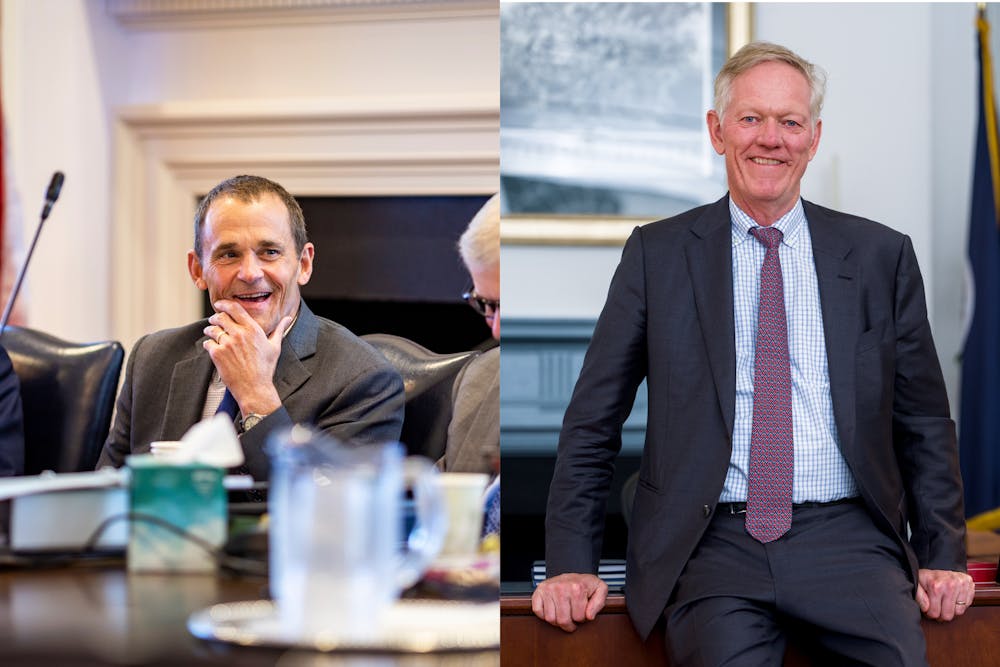
After his controversial appointment by the Board of Visitors in December, some news organizations and observers on social media predicted that University President Scott Beardsley would not occupy Madison Hall for long.
Now, with a new Board backing his leadership and preliminary work underway for the president to develop his own strategic plan, Beardsley’s chapter of University governance is taking shape. Beardsley’s first six months, considered essential for the success of any university president by McKinsey and Company, are now in the rearview mirror.
Beardsley faced a destabilizing set of factors which immediately threatened his presidency. These included a uniquely short transition period into the role and public opposition from University stakeholders to the Board which appointed him. Still, Beardsley appears to have responded to the situation he entered in a manner similar to how former University President Jim Ryan approached his early days as University president approximately eight years ago — engaging in extensive, one-on-one conversations with stakeholders and balancing short-term continuity with long-term strategic planning.
Ryan took office in 2018 in the aftermath of the Unite the Right rally in Charlottesville, and amid heightened conversations about the University’s role within the broader Charlottesville community. Here is a closer look at how Beardsley’s early tenure compares to that of his predecessor, Ryan.
Jim Ryan, 2018
Almost nine years ago, Ryan — then dean of the Harvard Graduate School of Education — watched on from Cambridge, Mass. as a torch-wielding group of white nationalists marched on the Lawn at his alma mater. The “alt-right” activists gathered for the Unite the Right rally to protest the removal of a Robert E. Lee statue from Market Street Park in Charlottesville, Aug. 11, 2017.
The next day, the same group protested in the City, and a car plowed through a street culminating in 19 injuries and the murder of counter-protester Heather Heyer. Two police officers also died in a separate helicopter crash while monitoring the rally.
Unite the Right occurred six months into the University’s ninth presidential search, and weeks later, the Board approached Ryan and offered him the position as president of the University. On the one-year anniversary of the rally, Ryan said the memories of Aug. 11-12, 2017, were a “big part” of what motivated him to accept the role.
The morning of his election by the Board Sept. 15, 2017, Ryan — who graduated from the School of Law in 1992 and previously served as an associate dean, distinguished professor and founder of the Program in Law and Public Service at the School — was formally reintroduced to the community on the steps of the Rotunda.
In his speech to the University community, Ryan said he was “heartbroken and horrified,” emphasizing the need for the University to remain diverse, equitable and inclusive “in an era where some choose prejudice, bigotry and racial violence.” He listed no immediate, tangible plans for his presidency, instead expressing a desire to meet with stakeholders during an extensive transition period as he shaped a more policy-specific agenda.
Ryan had 320 days to prepare for his presidency — more time than his two immediate predecessors, former University President Teresa Sullivan and former University President John Casteen. In fact, his transition into office was originally scheduled to last over a year for a term beginning Oct. 1, 2018. However, the Board voted in March 2018 to amend Ryan’s election, shifting the start date to the beginning of August.
Much of Ryan’s 320-day transition period was spent in meetings with stakeholders on Grounds. The meetings gave Ryan an opportunity to gather extensive community input in sketching a broad outline for what would become his 10-year “Great and Good” 2030 strategic plan. From the outset, Ryan espoused an ambition to develop this 10-year plan to make the University America’s leading public higher education institution by 2030, and these were some of the earliest conversations dedicated to directly shaping that agenda.
By the end of May 2018, Ryan had met with all of the University’s vice presidents. Ryan also traveled to Charlottesville about once a month to meet with the University’s deans, its faculty members and staff members. Off Grounds, Sullivan accompanied Ryan to meet the General Assembly’s Republican and Democratic legislative leaders in 2018. Former Gov. Ralph Northam (D) attended Ryan’s inauguration, and went on to appoint Ryan to Virginia’s Innovation and Entrepreneurship Investment Authority in February 2019.
At a press conference on his first day as president in the Dome Room of the Rotunda, Ryan indicated that he had narrowed down three key themes which would define his presidency and which later became the foundation of the strategic plan — including “community, discovery and service.” During a Board retreat Aug. 3-4, 2018, Ryan also told Board members that he aimed to have a guiding vision statement for the plan crafted within his first 100 days in office.
Ryan formally launched “Ours to Shape” — an initiative dedicated to receiving continued community input online — and held over 100 in-person outreach sessions to hear from stakeholders as his office developed the plan. Through these mediums of outreach, the University identified almost 50 actionable ideas which could be included in a potential strategic plan. University leaders then discussed amongst themselves and narrowed the list down to the 10 initiatives which made their way into the final document.
Also informing Ryan’s early governance strategy was a separate 16-member community working group that he commissioned in October 2018. Composed of University community members and prominent City residents — like members of local nonprofits and Juandiego Wade, Charlottesville mayor and then-Charlottesville School Board chair — the group sought to identify specific factors contributing to the strain in City-to-Grounds relations. It returned a report with seven areas of focus for Ryan, placing special emphasis on jobs and wages as priority areas where the University — as the City’s largest employer — could begin taking actions to mitigate this strain. Ryan eventually raised the minimum wage for benefits-eligible workers at the University to $15 an hour in 2019.
Committee recommendations which made their way directly into the 2030 plan include the development of a Center for the Redress of Inequity Through Community-Engaged Scholarship — now called the Center for Community Partnerships — which seeks to tangibly and continuously redress the relationship between the University and City.
On the advice of the working group, the plan also contains explicit commitments to collaborating with the Charlottesville community to ensure access to housing, healthcare, living wages and educational opportunities for working locals. Wade, who served as co-chair of the working group, elaborated on two specific University initiatives in these goal areas in a statement to The Cavalier Daily May 28. The first, the Pipelines & Pathways program, has assisted hundreds of Charlottesville residents with finding entry level job opportunities at the University. The second, an affordable housing initiative, has committed to donate land for up to 1,500 affordable homes in the City to be built by 2030.
“Although it is not perfect, U.Va. is working to fulfill the goals of the University Community Working group,” Wade wrote.
The 2030 plan is still working actively, and in February, University Spokesperson Bethanie Glover asserted that the outlined initiatives are on track to be completed by 2030, despite the leadership changes of the past year.
As he prepared to assume office, Ryan also received briefings on the evolving situation in Charlottesville in the aftermath of Unite the Right. Ryan came into the role amid criticisms of the University Police Department’s response to the Aug. 11, 2017 march on Grounds. An independent report conducted by Tim Heaphy, founding partner of Heaphy, Smith, Harbach and Windom LLP and former U.S. attorney for the Western District of Virginia, found that UPD had denied multiple offers of assistance from the Charlottesville Police Department that night, and opted not to place barriers between protesters and counter-protesters despite receiving intel that the confrontation could turn deadly.
In what marked his first public address as president, Ryan spoke at an organized commemorative event Aug. 11, 2018 in New Cabell Hall to mark one year since the Unite the Right rally. In the speech, titled “The Imperfect Pursuit of High Ideals,” Ryan apologized on behalf of the University for the role it played in enabling Unite the Right, including graduating two of the hate rally’s organizers — Jason Kessler and Richard Spencer. He stressed that the University must remain committed to the values of inclusivity and tolerance even if there will always be gaps between its “aspirations and reality.”
Amid Kessler’s attempts to organize a “Unite the Right 2” in Charlottesville on the original rally’s anniversary — which the City blocked — the University spent roughly $423,000 on a police presence on Grounds as a precautionary measure. The University also appointed Gloria Graham, associate vice president for safety and security, in April 2018 who worked to coordinate the law enforcement response to any unlawful acts of assembly that weekend between UPD and local and state police. As part of Graham’s efforts, she oversaw joint trainings and implemented a coordinated emergency response structure between the three entities.
Around this time as well, a Virginia Magazine article indicated Ryan exerted considerable influence over several University appointments. These included the selection of Mary Elizabeth Magill, who worked with Ryan as vice dean at the Law School, to the position of University provost in July 2019.
In appointing core members of his team, Ryan cast a wide net, hiring candidates from a variety of schools and backgrounds. Ryan’s core support team included Margaret Grundy, a former vice president and chief Student Affairs officer at the University, as his chief of staff, Kyle O’Connor, a former speechwriter for President Barack Obama, as a senior assistant to the president and speechwriter and Matt Weber, former multimedia director for the Harvard Graduate School of Education, as a senior assistant to the president.
Ryan’s inauguration officially took place Oct. 19, 2018 on the steps of Old Cabell Hall.
Scott Beardsley, 2026
Student Council, the Faculty Senate, Wahoos4UVA and nine University deans condemned the 10th presidential search as “rushed” and illegitimate. They questioned the legal basis for Beardsley’s appointment, as the Board that made the decision had less than 12 alumni and 12 Virginians serving in its ranks as required by state law. Gov. Abigail Spanberger (D), then preparing to take office, had asked the Board to delay a presidential appointment until after she became governor Jan. 17, promising to fill five vacancies immediately to address the concerns with the Board’s legal status.
Despite calls for a pause, the Board issued the appointment at a special meeting Dec. 19. By the end of the month, Beardsley was leading the Commonwealth’s flagship University after a 12-day transition period — the shortest in the 122-year history of the role for a permanent president.
During his first speech as president-elect Dec. 19 in a conference room of the Old Ivy Office Building, Beardsley committed to building trust within the community. He pledged to dedicate the months ahead to engaging directly with stakeholders. Given the brevity of Beardsley’s transition, these initial conversations with administrators, student leaders, alumni and donors lasted well into the beginning of his term.
These early efforts to connect with the University community became known as the “Grounds for Conversation” listening tour — an effort for Beardsley to grasp some of the University’s biggest strengths and areas for improvement. The website defines these early interactions with community members as “engagements,” which have included meetings with stakeholders, students and faculty to broadly help him in his efforts to diagnose the University’s strengths and weaknesses.
In engaging extensively with stakeholders, Beardsley also grappled with the added complexity of organized opposition to his appointment on and off Grounds.
The appointment had drawn a particularly negative reception from state leaders. Beardsley and former Board Rector Rachel Sheridan testified at a Senate Finance and Appropriations Education Subcommittee meeting Jan. 12. At this meeting, Sheridan defended Beardsley’s appointment as apolitical, noting his qualifications for the role and emphasizing that the Board took the responsibility of hiring a president seriously.
For his part, Beardsley introduced himself to committee members and said he looked forward to working with them during his presidency. Beardsley also held individual outreach meetings with state legislators early into his term, and sat down with Spanberger for a private, 90-minute meeting Jan. 8, which he described as “a wonderful meeting,” noting that he looked forward to working with her as well.
Spanberger reshaped the Board’s composition Jan. 16 when she asked five Board members to resign from their posts. Shortly after her inauguration Jan. 17, she appointed 10 new members. Walt Heinecke, past president of the University’s chapter of the American Association of University Professors and associate professor of Education and Human Development, told The Cavalier Daily in January that he attributed the firing of Board members to the advocacy of a coalition in Charlottesville that included the Faculty Senate, Student Council, Wahoos4UVA and local legislators.
However, as Beardsley went about engaging with these constituencies, cracks began to show in the coalition Heinecke had described. Not all groups which advocated for the firing of Board members agreed on whether Beardsley should resign as well.
At a meeting with Beardsley Jan. 23, Clay Dickerson, former Student Council president and Class of 2026 alumnus, secured commitments of $500,000 for Support and Access Services — a branch of Student Council that offers free resources to students like textbook reimbursements, legal services and a shuttle service to nearby airports. Beardsley also agreed to partner with Student Council in a matching-funds campaign to raise money for its endowment and reduce its reliance on the Student Activities Fee, and affirmed continued discretionary support for University traditions like Lighting of the Lawn.
Four days after Dickerson’s meeting with Beardsley, the Council’s Representative Body unanimously passed a resolution affirming their support for Beardsley in the name of institutional stability. Some faculty members alleged that a quid pro quo had potentially taken place, though Dickerson asserted that Beardsley’s discretionary commitments had no bearing on the resolution’s passage.
Beardsley also met with newly-appointed members of the Board, which charged its Audit Committee with a close review of the appointment process, but ultimately affirmed its support for Beardsley at a meeting in March.
With the listening tour and engagements having already lasted roughly six months, Beardsley has begun to lay the groundwork for his own strategic plan. At a meeting of the full Board June 5, Beardsley indicated that he had narrowed several priority areas for this plan.
Included in Beardsley’s priorities are ensuring the University remains affordable through investment in programs like AccessU.Va., investing in the University’s research apparatus, clarifying the role of artificial intelligence in higher education, increasing the capacity of U.Va. Health and developing a sustainable financial model for athletics. These focus areas largely aligned with the broad set of priorities Beardsley identified in his speech to the Board in December, and to members of the Senate subcommittee in January.
The beginning of Beardsley’s tenure did not coincide with a series of major new hirings. The University is currently conducting a national search for a new executive vice president and provost — Beardsley served as chair of the search committee from September 2025 until two weeks after taking office in January, at which point he resigned from the committee. The University has commissioned two search committees to appoint a new provost thus far, and both were ultimately unsuccessful. The permanent appointment of a new provost is not expected until next academic year at the earliest, according to the University’s most recent update from March.
Beardsley also took office at a turbulent time for institutions of higher learning, amid unprecedented federal research cuts and crackdowns on DEI policies by the U.S. Department of Justice. Former interim University President Paul Mahoney signed a “ceasefire” agreement with the Justice Department Oct. 22, promising the University’s demonstrated compliance with the Department’s interpretation of Civil Rights Law through 2028.
Beardsley inherited this agreement when he took office in January, and indicated that he had no plans to change course from Mahoney’s administration on the issue.
At a press conference that took place immediately after his election, Beardsley told reporters that he admired Mahoney for stepping up to “help the University” in reaching this agreement. Since then, the University has released two compliance reports detailing how University practices abide by all civil rights law. In an interview with The Cavalier Daily in March, Beardsley indicated that he had not yet met with federal officials, but noted the importance of maintaining a strong relationship between the University and federal government.
Days after Beardsley called on the community in his acceptance speech to “move beyond division” and to “focus on what unites us,” he delivered his first public address as president in Old Cabell Hall Jan. 15, giving introductory remarks for an onstage discussion between Drs. Cornel West and Robert P. George on engaging in Socratic, productive dialogue when disagreeing with others.
Beardsley praised West and George’s commitment to open inquiry and said he believes it is in line with the University’s core mission of seeking knowledge. The event also kicked off the University’s celebration of UVA250, a University-wide celebration marking 250 years since the signing of the Declaration of Independence, which the Office of the President played an active role in.
Beardsley primarily maintained his close inner circle from the Darden School of Business when building a team within the Office of the President. Beardsley elevated Dean Krehmeyer — his chief of staff at Darden — to serve as vice president and chief of staff. Beardsley appointed Marc Johnson — former senior associate dean for student engagement and chief strategy and innovation officer at Darden — as vice president for strategic initiatives. He appointed Julie Daum — former chief marketing and communications officer at Darden — as deputy chief of staff for presidential and strategic communications.
There is not yet any public information as to whether Beardsley will be honored with an official inauguration ceremony, like all other nine permanent presidents of the University.

Luca Bailey is a third-year College student majoring in politics from Free Union, Va. As a staffer on the news and video desks, he has covered topics ranging from the General Assembly and state elections to local politics and University governance. He is also The Cavalier Daily’s beat writer for the Charlottesville City Council.
Read More
The ‘AI and Future of Work’ Series — How the University is preparing students for what is next
By Lidia Zur Muhlen | 1 hours agoIn a recent Gallup Inc poll, 79 percent of Americans believe that artificial intelligence will reduce the number of jobs over the next 10 years.

Tao Tan discusses financial future of U.Va., rising college tuition trend nationwide
By Lily Kostro | 20 hours agoTan explained how tuition costs will shape the future of academic institutions such as the University.

U.Va. Health cuts scribe hours as AI documentation tools expand across Health System
By Vrinda Vashisht | 20 hours agoScribes in the undergraduate medical scribe program said in interviews with The Cavalier Daily that a new emergency department schedule that began Sept. 15 has reduced or eliminated certain scribe shifts and has decreased scribe availability to clinicians in the Emergency Department.