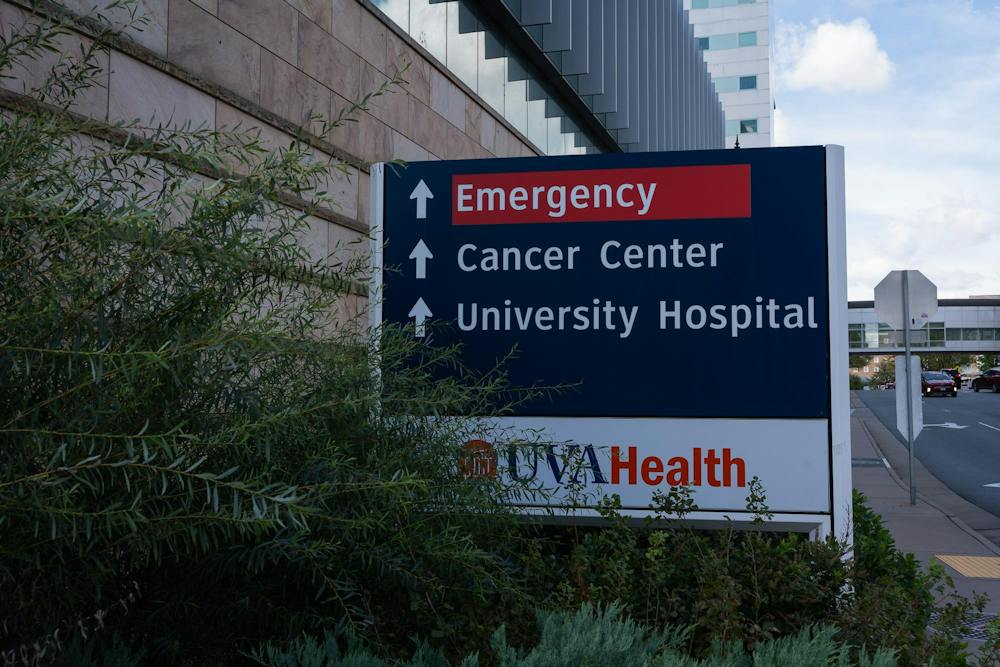
U.Va. Health implemented DAX Copilot — an ambient artificial intelligence tool that drafts clinical notes from recorded conversations between clinicians and patients — in 2025, according to a School of Data Science press release. Scribes in the undergraduate medical scribe program said in interviews with The Cavalier Daily that a new emergency department schedule that began Sept. 15 has reduced or eliminated certain scribe shifts and has decreased scribe availability to clinicians in the Emergency Department. A one-third reduction to the program’s annual budget was announced to scribes in April, according to William Collins, scribe and fourth-year College and Engineering student.
Dr. Scott Syverud, professor emeritus of emergency medicine, founded the Undergraduate Emergency Medicine Medical Scribe Program in 2007 along with five original scribes, according to the program's page. This program has allowed undergraduates at the University to work alongside clinicians and advanced practice providers in the emergency department, documenting patient history, physical exams and procedure notes in real time and tracking lab and radiology results. According to the program website, applicants must commit to a minimum of two years and — once hired — are expected to work 12 to 20 hours a week during the academic year and 30 to 40 hours during their first summer in the program. According to the scribes interviewed, this program is a major source of hands-on clinical experience before applying to medical school.
In an email statement to The Cavalier Daily, Collins said he joined the Scribe program in fall 2025, and that the role lets him “observe clinical decision-making in real time.” He noted that his statements to The Cavalier Daily reflect his own views and not those of the U.Va. Medical Scribe Program, U.Va. Health or any affiliated organizations.
"I get to be present when the residents teach the medical students what they need to know for shelf exams," Collins said. "I get to witness attendings guide their residents through complex procedures."
Shelf exams are standardized multiple-choice tests given to medical students at the end of their clinical rotations, usually in the third year of medical school. These tests are given to evaluate students’ knowledge on medical specialties.
Collins worked 16 to 20 hours nearly every week last semester and is now scheduled for 20 hours in the entire month of October, according to his statement. Scribes make between $13 and $13.50 per hour.
“The most notable change I've noticed [since DAX implementation] has been the loss of continuity,” Collins said. “Instead of accompanying a resident throughout an entire shift, we're increasingly present for only a portion of it … I'm getting less clinical experience, less income and less opportunities to learn.”
Dr. Sarah Wendel, assistant professor of emergency medicine and medical director of the U.Va. Health Emergency Department, confirmed that the scribe hours have decreased. While Wendel said that decision was made as part of broader budgetary changes, the arrival of DAX played a role.
"I didn’t make the budgetary changes. I think that this AI tool came into place, and then we, as a kind of a healthcare system budget, we always have to make cuts," Wendel said. "So it felt like if we had a tool embedded into the [Electronic Health Record] that is there, we should use it."
DAX runs through clinicians’ Health System-issued phones, using a technique that U.Va. Health’s patient FAQ page terms “ambient listening” technology to record a conversation.
According to the FAQ page and current scribes, not every provider uses DAX, and patients can decline the recording or stop it at any point during the visit. According to Wendel, the tool filters out conversation that is not related to the medical exam, and drafts a note on what is relevant. Wendel described how DAX can record a clinician’s process as they speak about the encounter with the patient while it is occurring — a practice known as dictating an exam.
“You can also dictate a physical exam,” Wendel said. “You can say ‘Now I'm going to do your physical exam’ [...] and can also dictate a little bit about what you're thinking and what the plan is as you kind of talk to the patient … If you say [this] while it's on, it dictates into your note, and you can actually have it all in your note after you've completed the physical exam and evaluation.”
Every note still requires review, Wendel said, because DAX can add language or misinterpret statements.
"It's important to validate the material that's put in the chart," Wendel said. "And that's the same for human scribes and AI scribes.”
Fourth-year College student Peyton Streu has been a scribe in the department for over two years. Streu said that he previously worked two to three eight-hour shifts per week. This semester, he works about once a week, often for four or five hours.
"I love coming here. I want to work, but it's so hard now because there's not enough shifts to go around," Streu said.
Fourth-year College Student Jenna Wade joined the program in the spring of her second year, and she said scribes previously worked the same shifts as the residents they were paired with.
"We used to work the same exact shifts as the residents — a common one was 7 a.m. to 3 p.m.," Wade said. "Now they have shortened that so that the scribe is only there for the busiest times of a resident’s shift. Today, I worked [from] 10 a.m. to 3 p.m. instead of what that shift typically used to be, seven to three."
Many scribes have also said DAX's shortcomings have shaped how residents actually use the platform. Streu said he believes that out of roughly 36 emergency medicine residents, only about two still use DAX when a scribe is present, as it often fills notes with irrelevant details.
"DAX honestly isn't very good," Streu said. "It messes up who's speaking … Having all that extra fluff in the notes, it's just not efficient."
When residents do use DAX, Collins said his role shifts from writing notes to editing them — reorganizing the notes by clinical relevance rather than chronology, double-checking accuracy and cutting what does not belong. He said the process often takes longer than writing a note from scratch.
"There is a huge difference between documenting every single word that was said and documenting what matters clinically," Collins said. "A patient's story rarely unfolds in the same order that it belongs in a medical note and part of my job [as a scribe] is to piece together that narrative in a way that accurately reflects their presentation while providing a coherent narrative for the ones treating them.”
Wade said physical presence in the patient room is vital when scribing because of nuances recordings may miss.
“Especially with physical exams, sometimes patients won't be the most clear when referring to specific locations where their pain or injury might be occurring,” Wade said. “So, for example, they might point to their arm and just say the pain is ‘here.’ And since we're physically in the room, we can see that they're pointing at their forearms. Just the word 'here' isn't enough to clue DAX into what the patient is specifically referring to.”
Collins echoed a similar point about DAX’s approach to nonverbal cues and context for a patient’s situation, highlighting that DAX is not present for the entire encounter and therefore cannot transcribe all the pertinent information.
"The patient's history does not necessarily begin when DAX starts recording, nor does their care end when it stops,” Collins said.
George Kamberis, second-year College student and incoming scribe this academic year, said a radiologist he shadowed described AI’s limitations as a “purple cow effect.” According to Kamberis, the takeaway is that an AI model can recognize the color purple and can recognize a cow, but struggles to put the two concepts together.
"Until AI can perfect [the purple cow effect], AI is just going to be a supplementary tool to human scribing [and] human note-taking,” Kamberis said.
Wendel recognized that scribes do work an AI tool cannot replicate, such as gathering medical tools and tracking patient records.
"I will look at the scribe and say, 'Get me blank,' or 'Get the ultrasound.' They are an integral part of that healthcare team. Although they are not putting hands on the patient, they are making sure that we have records, that we have an ultrasound that works, that we're getting the information from the family member who's speaking in Farsi."
Dr. Richard Andrew Taylor, professor of emergency medicine and vice chair for research and innovation, said decisions to adopt tools like DAX are typically made for U.Va. Health as a whole and then implemented to individual departments after — no department independently made the decision to implement DAX. He said the technology's main goal is reducing what he calls "pajama time" — when a physician completes patient documentation at home after a shift.
"There were a lot of conversations about recognizing this technology [that] is being introduced. Can we start to rethink [about] what medical scribes have historically done," Taylor said. "Recognizing that, yes, it's this amazing kind of educational and career-oriented pipeline, and we don't want to lose that."
According to Taylor, utilizing an AI tool for documentation is only the first step for the companies building clinical AI tools. He said companies plan to connect notes to medication billing and support clinical decision-making through possible diagnoses and pre-population of clinician orders for approval.
Taylor named two concerns about the trajectory of clinical AI tools — trainees could lose practice in their own clinical reasoning, and time saved on documentation could be converted into pressure to see more patients.
"People really worry about deskilling and learning effective clinical reasoning from an educational front,” Taylor said. “The worry amongst physicians is that there's going to be a tendency towards increasing automation and acceleration of clinical care, so … [there] is the expectation that I see … additional patients that I was not seeing before, and so there's a worry that the assembly line will start to move faster than it was before."
Taylor continued, adding that physicians have not yet decided what the best approach is regarding how to change the number of patients seen in a given time now that technologies like DAX are being used. U.Va. Health's patient FAQ on DAX lists the outcome of clinicians seeing more patients in less time as a benefit — the tool "may also help providers see more patients in less time," which can reduce wait times and improve access to care.
Both Taylor and Wendel said the Emergency Department is actively trying to preserve the medical scribe program’s educational value.
"Our head scribes last year did a lot of work on cataloging everything the scribes are doing and figuring out what's the value proposition [of the scribe role] and things like that,” Wendel said. “So we have all that information, and now we're trying to translate that into a new role."
Taylor separately described what a possible refined role may be — a hybrid model in which DAX generates the note while a scribe manages a live information dashboard, relaying updates to the clinician and placing preliminary orders for approval. This system, he added, may not be feasible for all environments.
“In the ambulatory care environment, there's a need to have that kind of heavy information burden [be] shifted, but I think there are other scenarios where there is more time and probably less of a stringent kind of need to [adopt a hybrid DAX-Scribe model],” Taylor said.
When discussing the importance of medical scribing in the face of multiple AI development tools, both Wendel and Taylor would still recommend scribing despite the growing role of AI in the Emergency Department. According to Taylor, no other entry-level role “provides that opportunity” to see upwards of 50 to 60 patients alongside a physician on a single triage shift.
Wendel said the structured, team-based nature of the role — as opposed to shadowing a clinician — gives scribes something concrete to point to later in their academic and medical careers.
"They can draw on a lot of those opportunities to say, 'Oh, no, I've actually been part of a team like this,'" Wendel said. "I didn't really have a longitudinal relationship [before applying to medical school], and so that's why I think it's so important that we keep something and kind of continue to move with the times."
Collins also provided a reflection in his written statement to The Cavalier Daily.
"As a biomedical engineering student, I spend much of my time studying how emerging technologies can transform medicine," Collins said. "As a medical scribe, I get to witness what happens when those technologies are actually integrated into patient care. The future of medicine will undoubtedly involve more and more technology, but I really and truly hope we never make the mistake of replacing the value of human experience, emotion and connection."
Wendel said she hopes the Emergency Department can keep finding ways to include students, even as it leans further into the technology.
"I, although [I] love the technology, want to continue to have students," Wendel said. "That's where I hope we can look through student interactions — how we can continue to have students in the department, even if we're using this AI scribe."
Vrinda Vashisht is a staff writer on the news desk. She is a second-year College student studying Neuroscience.
Read More

Tao Tan discusses financial future of U.Va., rising college tuition trend nationwide
By Lily Kostro | 11 hours agoTan explained how tuition costs will shape the future of academic institutions such as the University.

How does the Honor Committee manage its endowment?
By Isabela Delgado | YesterdayThe Honor Committee manages an endowment upwards of $200,000, and for its 2026-27 academic term, it has budgeted $204,500 — just over its available endowment.
Provost search committee seeks Faculty Senate’s Executive Council input on qualities for next provost
By Jaylynn Perez and Cassidy Hazel | 2 days agoBrie Gertler, interim executive vice president and provost, also provided updates on the University’s developing approach to artificial intelligence.